
Root Canal in One Sitting vs. Multiple Appointments: What Actually Happens
The Question I Hear Most Often
You’re sitting in the chair, your tooth is throbbing, and I’ve just told you that you need a root canal. Your first question–almost always–is: "Can’t you just do it all today? Do I really have to come back multiple times?"
I get it. You’re in pain, you’re anxious, and the thought of multiple dental visits feels overwhelming. The good news? In many cases, we absolutely can complete the entire root canal treatment in a single sitting. But here’s what matters: understanding why that’s possible now, when it actually makes sense, and what happens during that appointment so you know exactly what to expect.
Let me walk you through the real story behind single-sitting root canals–not the marketing version, but what actually happens in the chair.
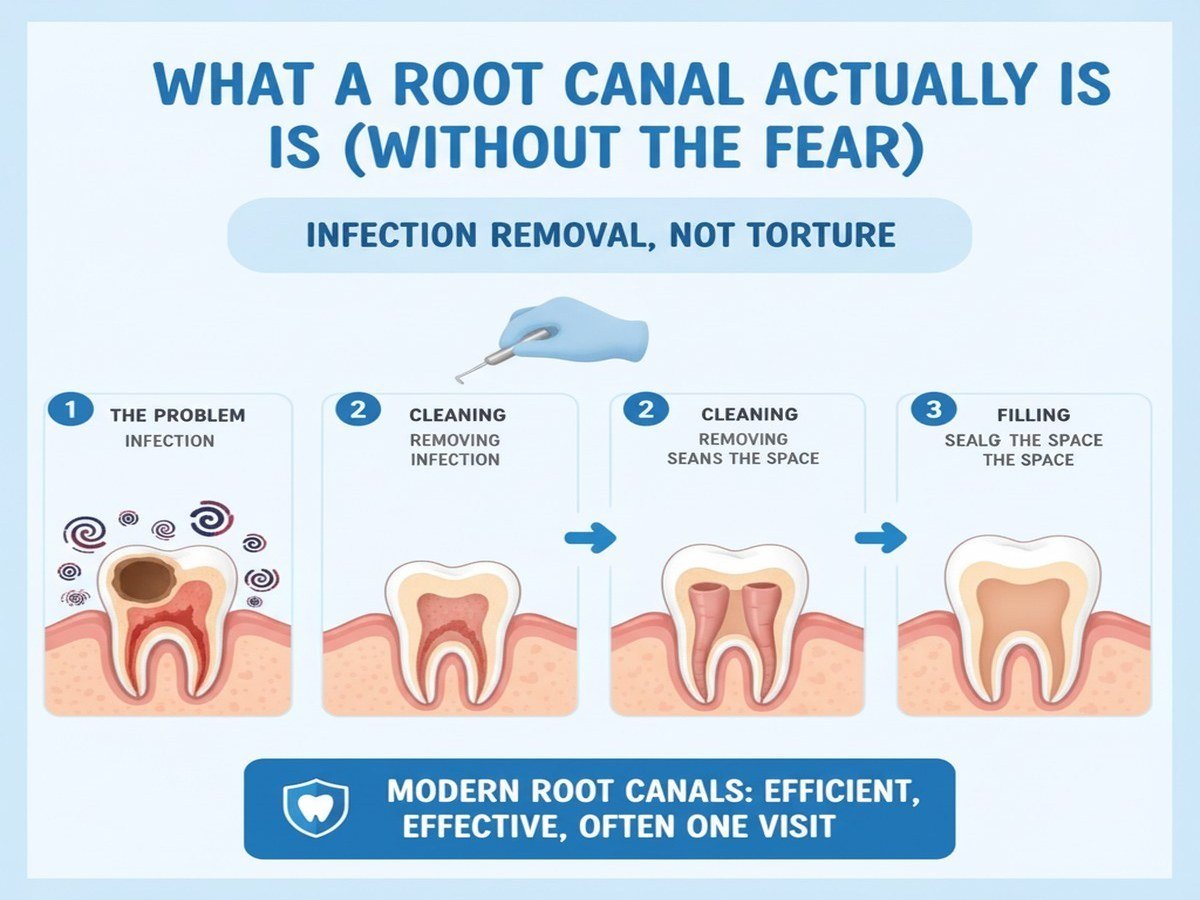
What a Root Canal Actually Is (Without the Fear)
Before we talk about timing, let me demystify what we’re actually doing.
Inside your tooth is a space filled with nerve tissue and blood vessels–we call this the pulp. When bacteria get deep inside (usually through decay or a crack), that pulp becomes infected and inflamed. Your body responds with pain, swelling, and sometimes an abscess. A root canal is simply the process of carefully removing that infected pulp, cleaning and shaping the space, and sealing it back up so bacteria can’t return.
That’s it. It’s not torture. It’s infection removal.
The reason you might have heard about root canals taking multiple visits is historical. Years ago, the technology and materials we had made it safer and more predictable to spread the work across appointments. We’d clean the canal, place a temporary medication inside to keep bacteria at bay, and bring you back a week or two later to finish the job.
That approach still has its place. But modern equipment, better materials, and refined techniques mean we can often do the entire procedure–from start to finish–in one session.
Single-Sitting Root Canals: How We Do It
When you come in for a single-sitting root canal at Pune Dental Studio, here’s what actually happens.
Step 1: Diagnosis and Local Anesthesia
First, we confirm exactly which tooth is infected using digital X-rays. Once we’re certain, I apply a specialized topical numbing gel–stronger than what most clinics use–directly onto the gum before the injection. This matters because the needle itself is often what people fear most. By the time you feel the injection, your gum is already deeply numb, so the freezing sensation is barely noticeable.
We wait a few minutes for the local anesthetic to fully take effect. You should feel complete numbness in the tooth and surrounding area.
Step 2: Isolation and Access
Next, I place a rubber dam around the tooth. Yes, I know it sounds uncomfortable, but it’s actually one of my favorite tools because it keeps the tooth completely dry and isolated from saliva and bacteria. This is non-negotiable for a successful root canal. A dry field means I can see clearly, work precisely, and minimize the risk of contamination.
Then I create a small access opening in the crown of the tooth–this is how we reach the pulp chamber inside.
Step 3: Pulp Removal and Canal Exploration
Using specialized instruments called files, I carefully remove the infected pulp tissue from the main chamber and then begin exploring and enlarging the root canals themselves. Most teeth have one to four canals, and each one needs to be found, cleaned, and shaped.
This is where precision matters enormously. I use a combination of hand instruments and rotary files, working methodically from the coronal (top) part of the canal down toward the apex (tip of the root). The goal is to remove all infected tissue and create a uniform shape that can be sealed effectively.
Step 4: Working Length Determination
To make sure I’m cleaning the entire canal and not going beyond the root tip (which would cause damage to the bone), I take a small X-ray with a file inside the canal to confirm the exact working length. This takes just a minute and gives me the precision I need.
Step 5: Thorough Cleaning and Shaping
Once I know the working length, I systematically enlarge and shape each canal using progressively larger files. Throughout this process, I’m irrigating with antimicrobial solutions to flush out debris and kill remaining bacteria. This step typically takes 20 to 40 minutes depending on the complexity of the canal system.
You might feel vibration, pressure, or hear the sound of the rotary instruments. You shouldn’t feel pain–if you do, let me know immediately and we’ll add more anesthetic.
Step 6: Obturation (Sealing)
Once the canals are cleaned and shaped, they need to be sealed completely to prevent bacteria from re-entering. I use a combination of gutta-percha (a biocompatible rubber-like material) and a specialized sealer cement. The gutta-percha is warmed and compressed into the canal space, filling it from the apex all the way to the chamber.
I then remove the excess from the access opening, and we verify the seal with another quick X-ray.
Step 7: Temporary or Permanent Restoration
Once the canal is sealed, the access opening needs to be closed. For a single-sitting root canal, I typically place a tooth-colored composite filling to seal the access hole. If the tooth has significant damage or will need a crown later, I might place a temporary restoration instead, and you’d return for the crown placement in a separate appointment.
Single-Sitting vs. Multiple Appointments: The Real Comparison
So when does one sitting make sense, and when is it better to spread it across visits?
Single-Sitting Root Canals Work Best When:
The tooth is uncomplicated. Straight canals, clear anatomy, and good visibility make the procedure faster and more straightforward.
You’re in acute pain and infection. Sometimes bringing you back while an infection is still present carries risk. Completing the treatment in one session eliminates that window.
You have a simple crown or filling. If the tooth hasn’t had extensive previous work, there’s less complexity.
You’re reliable about follow-up care. A single-sitting treatment means you’ll need to return for a crown or final restoration. If you’re someone who schedules appointments consistently, this works smoothly.
You have good pain tolerance and time. A single-sitting root canal typically takes 60 to 90 minutes. You need to be comfortable sitting still and having the procedure completed without breaks.
Multiple Appointments Might Be Better When:
The canal system is severely curved or calcified. Some teeth have canals that are difficult to navigate. Spreading the work across visits gives the tooth time to settle and reduces the risk of file breakage or procedural errors.
There’s a large periapical lesion (bone infection). Sometimes the infection extends into the bone around the root tip. Placing a medicated dressing inside the tooth for a week or two before final sealing can help the bone heal better.
You’re anxious or have limited time. If sitting for 90 minutes feels overwhelming, breaking it into two 45-minute appointments is completely reasonable and often leads to better outcomes because you’re more relaxed.
The tooth has had previous root canal treatment. Re-treating a tooth that’s already been worked on is more complex. Multiple visits allow for careful assessment and staged treatment.
You have a complex crown or post. If there’s already a crown or post in the tooth, accessing and treating the canals takes longer and benefits from a staged approach.
What to Expect After Your Root Canal
Here’s what I tell every patient after we finish:
Some tenderness is normal. Your tooth and the surrounding area have been worked on, and the bone around the root tip is inflamed. Over-the-counter pain relief (ibuprofen or acetaminophen) usually handles this well. Most people feel significantly better within 24 to 48 hours.
Avoid chewing on that tooth. A tooth that’s had a root canal is more brittle because it’s no longer living. Chew on the other side until we place a crown.
The temporary filling isn’t permanent. If I placed a composite filling to seal the access hole, it’s meant to last a few weeks to a few months. Don’t delay getting a crown placed, because a tooth without a crown after root canal treatment can fracture.
You might feel slight pressure or sensitivity. Some patients report that the tooth feels "different" for a few days. This is normal inflammation settling down.
Watch for signs of problems. If you develop severe pain that doesn’t respond to medication, significant swelling, or a pimple-like bump on the gum, contact us. These are rare, but they need attention.
Why We Choose Single-Sitting When We Can
I’ll be honest about why I often recommend single-sitting root canals when the tooth is suitable:
It’s not about rushing you through. It’s about reducing your overall anxiety and time commitment. You come in once, we solve the problem, and you leave knowing the infection is completely gone. You don’t have to worry about that tooth for the next week. You don’t have to schedule another appointment and relive the anxiety. You don’t have to wonder if something went wrong between visits.
For many people, that peace of mind is worth sitting for 90 minutes.
But I also know that for some patients, especially those with significant dental anxiety, breaking it into two calmer, shorter visits is the better choice. There’s no shame in that. The goal is a successful treatment, and that only happens when you’re comfortable enough to trust the process.
The Technology That Makes It Possible
One reason single-sitting root canals have become more reliable is better equipment. At Pune Dental Studio, we use digital imaging, rotary instruments with torque control, and electronic apex locators–all tools that reduce the time and guesswork involved in canal treatment.
We also have the luxury of an unhurried approach. I’m not racing through your appointment because the next patient is waiting. We take the time needed to do it right, whether that’s 60 minutes or 90.
Common Questions About Single-Sitting Root Canals
Does doing it all in one sitting increase the risk of failure?
No. When the tooth is suitable for single-sitting treatment and the procedure is done carefully, success rates are comparable to multi-visit root canals. What matters is thorough cleaning, proper shaping, and complete sealing–not how many appointments it takes.
Will my tooth be completely numb the entire time?
Yes. We check your numbness before we start, and if you ever feel sensation during the procedure, we add more anesthetic. You should never feel sharp pain during a root canal.
What if I can’t sit still for 90 minutes?
Tell me beforehand. We can absolutely break it into two appointments. There’s no penalty, and honestly, some people do better with that approach.
Is the cost different for single-sitting vs. multiple appointments?
Pricing depends on the complexity of the tooth and the materials used, not on how many visits it takes. I’ll share exact pricing with you in writing before we start, so there are no surprises.
What happens if something goes wrong during the procedure?
It’s rare, but if a file breaks or we encounter an unexpected complication, we have options. Sometimes we can work around it in the same visit. Sometimes we pause and bring you back. Either way, we’ll discuss it with you and make sure you understand the next steps.
Do I need a crown after a root canal?
Most of the time, yes. A tooth that’s had root canal treatment is no longer living, which makes it more brittle and prone to fracture. A crown protects it and gives it years of additional life. We can discuss crown options and timing during your appointment.
What Happens Next
If you’re dealing with tooth pain or suspect you need a root canal, the first step is a proper diagnosis. We’ll take digital X-rays, examine the tooth, and talk through your options–including whether single-sitting treatment makes sense for your specific situation.
I’ll never push you toward single-sitting just to get you out the door faster. My goal is to recommend the approach that gives you the best outcome and fits your comfort level.
If you’re in Baner and ready to address that painful tooth, reach out. We can schedule a consultation, answer your specific questions, and create a treatment plan that works for you. No pressure, no surprises–just clear information and care that actually listens to your concerns.
Your tooth doesn’t have to hurt, and root canal treatment doesn’t have to be something you dread. Let’s fix it together.
Dentistry that feels like a deep breath.
See it for yourself – your first visit is a conversation, not a commitment.
Book a Visit