
Managing Dental Anxiety: Tips and Tricks for a Stress-Free Visit
You’re Not Alone in This
Your hands are clammy. Your heart rate picks up the moment you see the clinic door. Maybe you’ve been putting off that filling for six months, or you cancel appointments the night before. If this sounds familiar, you’re in good company–dental anxiety is one of the most common reasons people avoid the care they actually need.
I’ve been practicing dentistry since 2006, and I can tell you with absolute certainty: your fear is real, it’s valid, and it’s completely manageable. The secret isn’t willpower or "just getting over it." It’s understanding what triggers your anxiety, knowing what to expect, and finding a clinic that’s designed with your nervous system in mind.
Let me walk you through what I’ve learned from thousands of conversations with anxious patients–and what actually works.
Why Dental Anxiety Happens (And Why It’s Not Your Fault)
Dental anxiety usually comes from one of three places.
Fear of the unknown. You sit in the chair and have no idea what’s about to happen. The dentist talks in jargon. Instruments appear without explanation. Your mind fills in the blanks, and the blanks are usually scary.
Loss of control. Someone’s hands are in your mouth. You can’t speak. You can’t easily stop the procedure if you need to. That feeling of helplessness triggers a primal stress response.
Sensory overload. The high-pitched whine of the drill. The sharp smell of the clinic. The taste of chemicals. The feeling of water and instruments in your mouth all at once. If you’re already anxious, your nervous system treats these as threats.
None of this is weakness. It’s actually a sign that your nervous system is doing its job–protecting you. The goal isn’t to ignore that instinct. It’s to work with it.
Before Your Appointment: What You Can Actually Control
You have more power than you think to set yourself up for a calmer visit.
Talk to Your Dentist Beforehand
Don’t wait until you’re in the chair. Call or message ahead and tell them you’re nervous. A good dentist will take this seriously. At Pune Dental Studio, we ask about anxiety during your initial consultation so we can adjust our pace and communication from the start. This isn’t a weakness to hide–it’s essential information that helps us care for you better.
Ask Questions About What Will Happen
Request a walkthrough of the procedure before it begins. "What will you do first? What will I hear? What will I feel?" When you know what’s coming, your brain stops treating it as a threat. Ask if you can see the 3D scan of your mouth–seeing your own teeth on a screen, with a clear explanation of what needs to be fixed, makes everything feel less abstract and scary.
Bring Something to Ground Yourself
Many patients find it helpful to bring headphones and a playlist. Some clinics offer noise-cancelling headphones and calming music or nature sounds. Others use aromatherapy–the scent of lavender or eucalyptus can genuinely calm your nervous system. If your clinic has these tools, use them. If not, ask if you can bring your own.
Schedule Strategically
Don’t book your appointment at the end of a stressful day. Choose a time when you’re not already wound up. Morning appointments often feel calmer. And if possible, book a longer slot rather than rushing–a 45-minute appointment where you’re not watching the clock is less stressful than a 20-minute scramble.
During Your Visit: The Modern Approach to Comfort
A lot has changed in dentistry over the past 15 years, and much of it is specifically designed to help anxious patients.
The "No-Gag" Revolution
One of the biggest triggers for dental anxiety is the gag reflex. Traditional impression trays–those plastic molds filled with gooey material that sit in your mouth for a minute–are torture for sensitive patients. Many modern clinics have replaced these with 3D intraoral scanners. It’s a tiny digital wand that takes a complete 3D map of your mouth in seconds. No gagging. No discomfort. Just a quick scan, and you’re done.
If your dentist offers this, definitely ask for it. If they don’t, it’s worth asking why–it’s becoming standard in patient-centered practices.
The Injection Protocol That Actually Works
Let’s be honest: the needle is often the scariest part. Here’s what changes the game: a strong topical numbing gel applied before the injection. When done properly, you shouldn’t feel the needle at all–just pressure. The freezing sensation that follows is uncomfortable for some people, but it’s temporary and predictable. Knowing it’s coming and that it will pass in 30 seconds makes a huge difference.
Ask your dentist to apply extra-strength topical numbing gel before injecting. It’s a small thing that makes a real difference.
You’re Always in Control
A good dentist will establish a signal with you–usually raising your hand–that means "pause." You can use this signal anytime you need a break, a moment to breathe, or just to remind yourself that you’re safe. The procedure will stop. You’re not being difficult. You’re being smart.
The Clinic Environment Matters More Than You Think
Where you sit while you’re being treated affects how you feel. A sterile, cold, clinical room with harsh lighting and that distinctive "dental smell" activates anxiety in your nervous system. You walk in and your body immediately goes into alert mode.
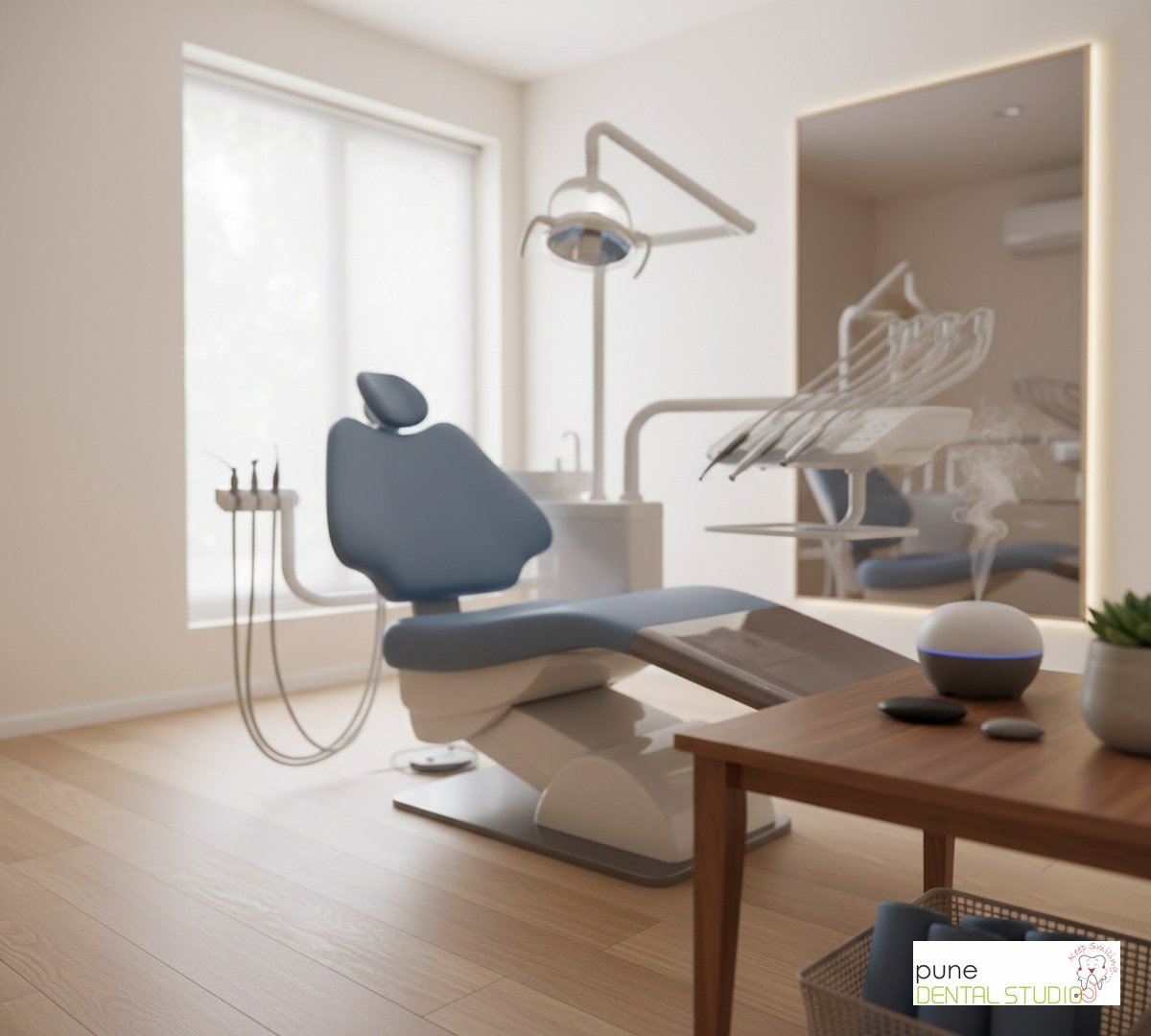
A well-designed clinic does the opposite. Warm lighting, soft colors, the absence of that clinical smell (replaced by something calming like lavender), comfortable seating, and even a living green wall–these aren’t luxuries. They’re tools that help your nervous system relax.
When you’re choosing a dentist, pay attention to how the space feels when you walk in. Does it feel like a spa or a hospital? Does it smell clinical or calm? These details matter.
What to Expect During Common Procedures
Here’s what some of the most anxiety-triggering procedures actually feel like, stripped of the mystery:
Cleaning and Scaling
You’ll feel vibration and water spray. There’s a suction tool that removes the water. The instruments are making noise, but they’re not painful–they’re just removing buildup from your teeth. The whole thing usually takes 30–45 minutes. Many people find it oddly satisfying once they relax.
Fillings
After numbing, you won’t feel pain–just pressure and vibration. You’ll hear the drill, but you won’t feel it cutting into your tooth. The hardest part is usually keeping your mouth open and staying still. The procedure itself is straightforward and usually takes 20–30 minutes.
Root Canal Treatment
I know the words "root canal" trigger panic in a lot of people. Here’s the truth: it’s not as bad as the reputation. After numbing, you won’t feel pain. You’ll feel pressure and hear noise. The procedure is methodical and takes time–usually 45 minutes to an hour. The relief you feel afterward (because the infected tooth stops hurting) is often surprising.
After Your Appointment: What Helps You Recover
Dental anxiety doesn’t end when you leave the chair. Here’s how to care for yourself afterward:
- Rest for a few hours. Your nervous system has been activated. Give yourself time to calm down.
- Avoid strenuous activity. Your body is in a mild stress state. Light activity is fine; intense exercise can amplify that feeling.
- Be gentle with yourself. You did something hard. Acknowledge that.
- Follow aftercare instructions carefully. Knowing you’re taking care of your teeth properly builds confidence for your next visit.
- Schedule your next appointment before you leave. This removes the anxiety of "when should I go back?" and keeps you on track.
Building Long-Term Confidence
The more you go to the dentist, the less scary it becomes. Your nervous system learns that the clinic is safe. The procedures are predictable. Nothing catastrophic happens. This is called habituation, and it’s powerful.
Each successful visit makes the next one easier. Start with a cleaning if you’re very anxious–it’s less invasive than a filling. Build your confidence gradually. Talk to your dentist about your progress. Celebrate the small wins.
After a few visits, many patients tell me they’re genuinely surprised at how calm they feel. The fear doesn’t disappear overnight, but it becomes manageable. And that’s the real goal.
Creating the Right Environment for Healing
At Pune Dental Studio, we’ve designed every aspect of the experience around one principle: your comfort is not a luxury–it’s essential to good care. We use 3D digital scanning instead of gag-inducing trays. We explain everything clearly before we do it. We offer noise-cancelling headphones, aromatherapy, and a calm, spa-like environment. We share your treatment plan and costs in writing before we begin, so there are no financial surprises.
Most importantly, we believe that anxious patients deserve care that meets them where they are. Not judgment. Not rushing. Just calm, clear, compassionate dentistry.
If you’ve been avoiding the dentist because of anxiety, I want you to know that there are clinics–and dentists–who understand what you’re going through. You don’t have to white-knuckle your way through an appointment. You don’t have to choose between your health and your peace of mind.
Frequently Asked Questions
Q: Is it okay to tell my dentist I’m anxious?
A: Yes, absolutely. A good dentist wants to know. It helps us adjust our approach, slow down, and explain things more thoroughly. It’s not an inconvenience–it’s essential information.
Q: Can I bring someone with me to my appointment?
A: Many clinics allow a trusted friend or family member to sit in the waiting area or even in the treatment room during your appointment. Ask ahead of time. Just having someone nearby can be reassuring.
Q: What if I need to stop mid-procedure?
A: You can always ask your dentist to pause. It’s your mouth, your body, your choice. A good dentist will stop without hesitation and give you time to breathe and reset.
Q: Will sedation help with my anxiety?
A: Some clinics offer sedation options for very anxious patients. This is something to discuss with your dentist. It’s not always necessary, but it can be helpful in certain situations.
Q: How do I know if a clinic is good for anxious patients?
A: Look for clinics that communicate clearly, explain procedures beforehand, use modern technology (like 3D scanners instead of impression trays), have a calm environment, and take your anxiety seriously. Read reviews from other anxious patients. Call and talk to the team–you can often tell from a conversation whether they understand what you’re going through.
Let’s Start This Together
Dental anxiety is real, but it’s not permanent. With the right approach, the right dentist, and a clinic designed for your comfort, you can get the care you need without the fear you’ve been carrying.
If you’re in Baner and ready to try a different kind of dental experience, we’d like to meet you. We’ll take time to understand your anxiety, explain everything clearly, and move at your pace. You’re in control. You’re safe. And you deserve care that respects both your health and your peace of mind.
Reach out to us at +91 98811 92594 or visit us at Office No 102, 1st floor, The Mint, Off Baner Road, Opposite Kapil Mallhar Society, Baner, Pune 411045. Let’s talk about what you need and how we can help.
You’ve got this. And we’re here to support you every step of the way.
Dentistry that feels like a deep breath.
See it for yourself – your first visit is a conversation, not a commitment.
Book a Visit