
Invisible Aligners or Metal Braces? A Parent's Breakdown for Teen Orthodontics
The Question Every Parent Asks Me
Your teenager needs orthodontics. You’ve done the research. You’ve seen the Instagram posts of kids with sleek, invisible aligners. You’ve also heard the stories about traditional metal braces – fast results, proven track record, but also the "brace face" era your generation might remember. Now you’re sitting in my chair asking the question I hear almost every week: Which one is actually right for my child?
Here’s the honest truth: there’s no universal "best" answer. What works brilliantly for one teen might be completely wrong for another. My job today is to walk you through what I’ve learned from 20+ years of helping teenagers straighten their teeth – the real pros, the real cons, and what actually matters when you’re making this decision.
Metal Braces: Still the Gold Standard (And Why)
Let me start with something that might surprise you: metal braces are still, in many cases, the most effective tool we have for complex orthodontic problems. And that’s not nostalgia talking – it’s physics.
Metal braces work by applying continuous, controlled pressure to teeth. A bracket is bonded to each tooth, connected by a wire, and that wire is adjusted every 4–6 weeks. The system is incredibly precise. I can move teeth in three dimensions – up, down, side to side, and even rotate them – with a level of control that’s genuinely hard to match.
The real advantages:
- Speed: For many cases, metal braces close gaps, fix bite problems, and straighten teeth faster than aligners. We’re talking 18–24 months versus 24–36 months in some situations.
- Complex bite correction: If your teen has an overbite, underbite, or crossbite that’s significant, braces are often the more reliable choice. They can fix problems that aligners simply can’t handle.
- No discipline required: The braces are there. They’re working. Your teen doesn’t have to remember to wear them (unlike aligners, which we’ll talk about).
- Cost: In many cases, metal braces are less expensive than invisible aligners.
The honest downsides:
- Visibility: Yes, they’re noticeable. That’s just the reality. Some teens are genuinely unbothered by this; others really struggle with it. I always ask the teen directly, not just the parent, because their comfort matters.
- Eating restrictions: Sticky foods, hard foods, popcorn, certain candies – they’re all off-limits or require careful management. This is a real lifestyle adjustment.
- Oral hygiene is harder: Food gets trapped around brackets and wires. Flossing requires special tools. If your teen isn’t naturally detail-oriented about brushing and flossing, braces can lead to plaque buildup and gum problems.
- Mouth soreness: The first week or two after getting braces, and after each adjustment, many teens experience soreness. It’s manageable, but it’s real.
- Occasional emergencies: A wire can break or a bracket can come loose. It happens. Usually it’s fixable, but it means an extra visit.
Invisible Aligners: Convenience With a Catch
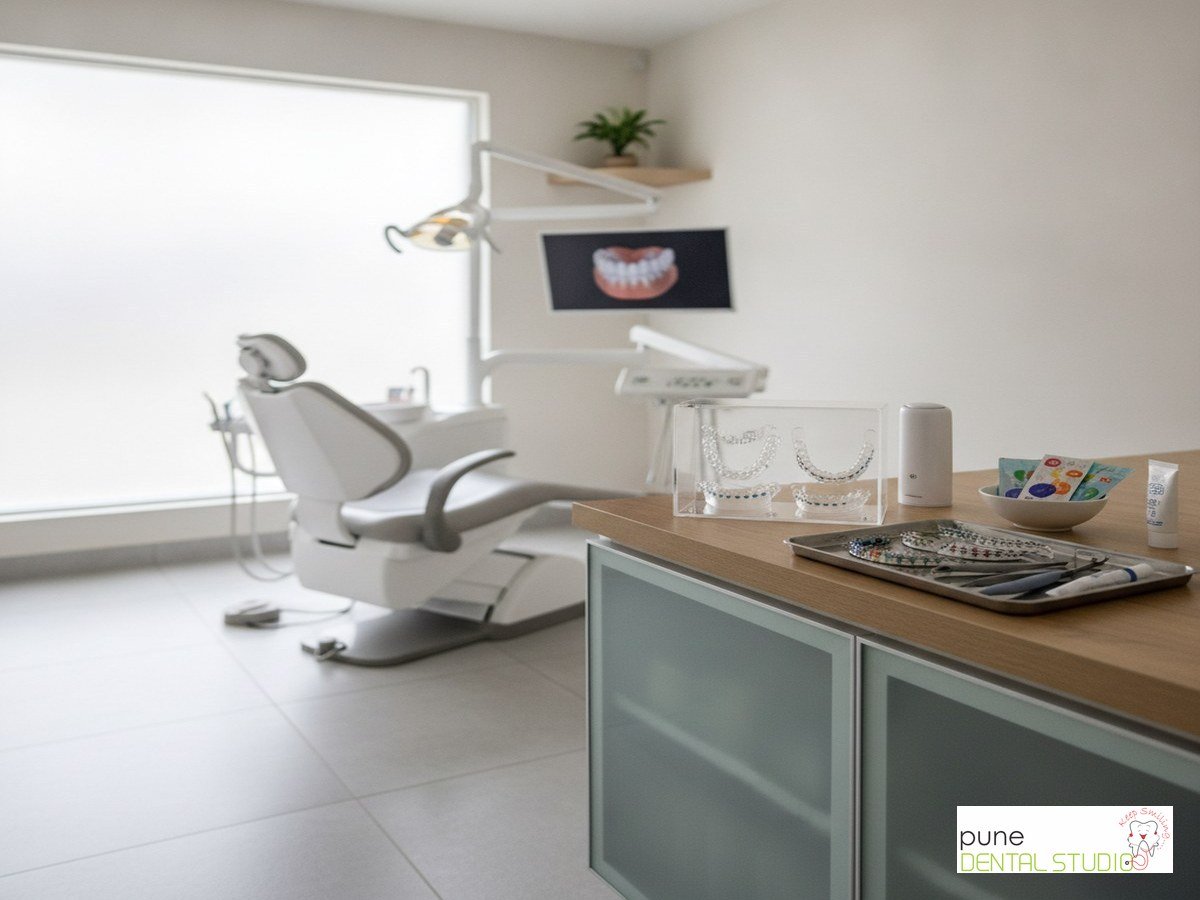
Now let’s talk about the aligners – the clear trays that have genuinely changed orthodontics for many patients. I use them here at Pune Dental Studio, and they’re fantastic when they’re right for the case.
Invisible aligners work differently than braces. Instead of continuous pressure from a fixed wire, aligners are a series of custom-made plastic trays. Your teen wears one tray for about 1–2 weeks, then switches to the next one. Each tray is slightly different, gradually moving the teeth into position. It’s like a choreographed dance – very precise, very controlled, but only if the dancer shows up.
Why teens (and parents) love them:
- Invisible: They’re clear. Most people won’t notice them unless they’re looking very closely. For a self-conscious teenager, this can be genuinely life-changing.
- Removable: Your teen can take them out to eat. No food restrictions. No sticky foods stuck in brackets. This freedom is huge.
- Easier cleaning: Without brackets and wires, brushing and flossing are straightforward. Gum health is typically easier to maintain.
- Fewer appointments: You’re not coming in every 4 weeks for adjustments. Usually it’s every 6–8 weeks, sometimes longer.
- Comfort: Once your teen adjusts to them (usually a few days), they’re generally more comfortable than braces. No sharp wires, no soreness from adjustments.
The real limitations:
- Requires discipline: This is the big one. The aligners only work if your teen wears them. The recommendation is 20–22 hours per day. That means they come out for meals and cleaning, then go right back in. If your teen is the type to lose things, forget things, or push back against rules, aligners can become a source of family conflict. I’ve seen cases where the teen simply won’t wear them consistently, and the treatment stalls.
- Not suitable for all bite problems: Severe overbites, underbites, and certain rotations are harder to fix with aligners. If your teen’s bite problem is complex, braces might be the only reliable option.
- Longer treatment time: On average, aligners take 3–6 months longer than braces for the same result. For a teenager, that can feel like forever.
- Cost: Invisible aligners are typically more expensive than metal braces. Not always, but often.
- Compliance is everything: If your teen doesn’t wear them, nothing happens. The teeth don’t move. Parents sometimes discover their child has been skipping them weeks into treatment.
Ceramic Braces: The Middle Ground (And Why I Mention Them)
There’s a third option that sometimes gets overlooked: ceramic braces. They work exactly like metal braces – same brackets, same wires, same effectiveness – but the brackets are tooth-colored or clear, making them much less noticeable.
They’re a genuine compromise if your teen wants the reliability of braces but is anxious about visibility. The downsides are that they’re slightly more expensive than metal braces and the ceramic can chip if bitten down on, but for many teens, it’s worth it.
So Which One Is Actually Right for Your Teen?
Here’s my decision-making framework, based on what I’ve seen work (and not work) hundreds of times:
Choose metal braces if:
- Your teen’s bite problem is complex (significant overbite, underbite, or crossbite).
- Your teen is young (under 14) and still developing.
- Your teen is not anxious about visibility, or is willing to accept it.
- You want the fastest possible result.
- Your teen tends to lose or forget things (the braces are always there, doing the work).
- Cost is a significant factor.
Choose invisible aligners if:
- Your teen’s bite problem is mild to moderate (mostly spacing or mild crowding).
- Your teen is self-conscious about appearance and genuinely motivated to wear them.
- Your teen is naturally responsible and detail-oriented.
- Your teen can commit to wearing them 20+ hours per day without you having to police them.
- Eating without restrictions is important to your teen (sports, social events, etc.).
- You’re willing to pay more for convenience and discretion.
Choose ceramic braces if:
- You want the reliability of braces but with less visibility.
- Your teen’s bite problem is moderate to complex.
- Your teen is willing to accept some visibility but wants it minimized.
What I Actually Tell Families in My Chair
When I’m sitting with a parent and teenager, I always say this: the best orthodontic treatment is the one that actually gets worn. If your teen hates the idea of braces so much that they’ll resist every day, aligners might be worth the extra cost and longer timeline, just for the sake of peace and compliance. But if your teen is young or has a complex bite, or if you suspect they’ll "forget" to wear aligners, braces are the more honest choice.
I also always involve the teenager in this decision. It’s their mouth, their face, their experience. A 14-year-old who feels heard and respected is much more likely to take care of their treatment, whatever we choose.
The Aftercare Reality (Both Options)
Here’s something parents often don’t ask about: what happens after the braces come off or the aligners are done?
Both braces and aligners require retention. Your teen will need to wear a retainer – usually for life, or at least for many years. This is non-negotiable. Teeth want to move back to where they started. A retainer prevents that. It’s usually a thin, clear appliance (similar to an aligner) or a fixed wire bonded behind the front teeth.
I tell families: the active treatment is 2–3 years. The retention is forever. It’s a small commitment, but it’s real.
A Word About Cost and Transparency
At Pune Dental Studio, I believe you should know exactly what you’re paying for before we start. I provide a detailed treatment plan in writing, with all costs itemized. No surprises at the end. Whether you choose braces or aligners, you’ll have clarity on the investment upfront.
Metal or ceramic braces start from ₹50,000 for the full treatment. Clear aligners start from ₹80,000, depending on complexity. These are starting prices; your actual cost depends on how complex your teen’s case is.
One More Thing: The Emotional Side
Orthodontics isn’t just about teeth. It’s about how your teenager feels in their own skin during some pretty formative years. I’ve seen kids gain real confidence when their smile straightens out. I’ve also seen kids feel self-conscious or frustrated during treatment.
My job is to give you the clinical facts and help you and your teen make a choice that feels right for your family. That might be the fastest option, the most invisible option, or the most affordable option. There’s no wrong answer – only the right answer for your situation.
FAQ
How long does treatment actually take?
Metal or ceramic braces: typically 18–24 months. Invisible aligners: typically 24–36 months. Complex cases can take longer with either option.
Will my teen feel pain?
With braces, there’s usually soreness for a few days after getting them and after adjustments. With aligners, there’s mild pressure but rarely sharp pain. Both are manageable.
Can my teen play sports with braces?
Yes, but a mouthguard is essential. With aligners, they can remove them during sports, which some athletes prefer.
What if my teen loses an aligner?
It happens. We can usually reprint it, but there’s a fee. This is one reason I emphasize that aligners require responsibility.
Do aligners work for all bite problems?
No. Severe overbites, underbites, and certain rotations are better treated with braces. We assess this during the consultation.
How often do we come in for appointments?
Braces: every 4–6 weeks. Aligners: every 6–8 weeks, sometimes longer. Fewer appointments can mean less disruption to school and activities.
Let’s Talk About Your Teen’s Smile
If you’re reading this, you’re already thinking carefully about what’s best for your child. That’s what matters. Whether you choose braces, ceramic braces, or aligners, the important thing is that you’re making an informed decision based on your teen’s needs, not just trends or what everyone else is doing.
I’d love to sit down with you and your teen, look at their specific situation, and help you figure out which path makes sense. We can do a digital scan, show you exactly what we’re working with, and talk through the options together – no pressure, no sales pitch, just honest conversation.
If you’re in Balewadi or nearby in Pune, reach out. Let’s get your teen smiling with confidence.
Call or WhatsApp us at +91 98811 92594, or visit us at The Mint, off Baner Road, Baner. We’re here to help.
Updated on 8 Oct 2026
Dentistry that feels like a deep breath.
See it for yourself – your first visit is a conversation, not a commitment.
Book a Visit