
Why Your Dentist Still Uses Impression Trays (And Why We Ditched Them)
The Question I Hear Every Week
A patient sits down in my chair, and before we even get started, they ask: "Will you be using those gooey trays? Because I really can’t do that."
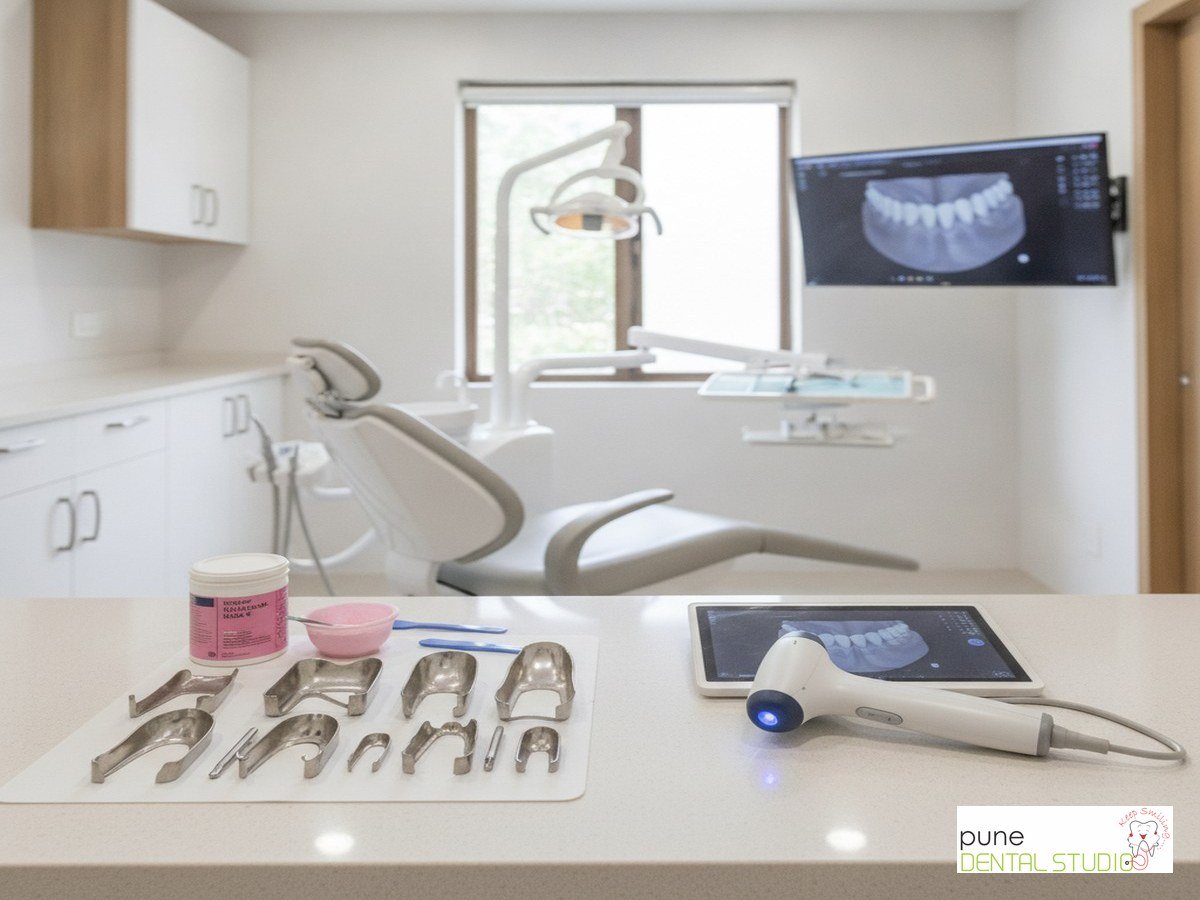
I get it. Impression trays are uncomfortable. They trigger gag reflexes, taste awful, feel invasive, and honestly? They’re outdated. Yet plenty of dentists still use them. At Pune Dental Studio, we made the deliberate choice to abandon them entirely in favour of digital 3D intraoral scanning–and I want to walk you through why, what changed for our patients, and what you should know if you’re deciding between the two approaches.
What Are Impression Trays, and Why Do They Still Exist?
Traditional impression trays are metal or plastic moulds filled with a gooey material (usually alginate or silicone putty) that you bite into for several minutes. The dentist then sends this physical mould to a lab, where technicians pour plaster into it to create a negative model of your teeth. From that model, they fabricate your crown, bridge, denture, or orthodontic appliance.
They’ve been around for decades. They work. They’re cheap. And because they work, inertia keeps them in place. Many dental schools still teach them as the standard. Many labs are set up to receive them. Many dentists haven’t invested in the alternative.
But "it works" is not the same as "it’s the best option for your patient."
The Real Problems with Physical Impression Trays
The Gag Reflex Nightmare
This is the biggest one. When you place a tray in someone’s mouth, you’re triggering their natural protective reflex. For some people, it’s mild discomfort. For others–especially those with dental anxiety–it’s genuinely distressing. I’ve had patients who’ve postponed necessary dental work for years because they couldn’t tolerate the impression process. That’s not acceptable to me.
Material Distortion and Accuracy Loss
Here’s something most patients don’t realise: once the impression material sets in your mouth, it can shift slightly as you remove the tray. The material itself can shrink or warp as it sits in the lab waiting to be processed. If the lab technician pours the plaster model incorrectly, accuracy compounds. By the time your crown arrives, it might be slightly off–not enough to be obviously wrong, but enough that you feel it when you bite, or it doesn’t fit quite right.
Time and Waste
A physical impression takes 5–10 minutes in the chair, then travels to the lab, gets processed, and comes back days later. If there’s an error, the whole cycle repeats. Digital scanning takes 2–3 minutes, uploads instantly, and can be corrected on the spot if needed.
Environmental and Hygiene Concerns
Alginate and silicone impression materials end up in landfill. They also require careful handling to prevent contamination during shipping. Digital data is just data–no physical waste, no cross-contamination risk.
How Digital 3D Intraoral Scanning Works (And Why It’s Different)
A 3D intraoral scanner is a handheld wand about the size of a dental mirror. It uses structured light or laser technology to capture thousands of data points from your teeth and gums in real time. Within 2–3 minutes, I have a complete, colour-accurate 3D digital model of your mouth.
That data goes directly to our lab or to milling software–no physical object, no shipping delays, no distortion. If I need to adjust something, I can do it instantly on the screen while you’re still in the chair.
What This Means for You
Comfort: No gag reflex. No taste of chemicals. No pressure or discomfort.
Speed: Scanning is faster than traditional impressions. Results are available immediately.
Accuracy: The digital model is precise to within fractions of a millimetre. There’s no shrinkage, no distortion, no human error in pouring plaster.
Transparency: You can see your own mouth in 3D on the screen. If we’re designing a crown or veneer, you can preview exactly what it will look like before we make it.
Flexibility: If we need to remake something, we have the original digital file forever. We don’t need to re-scan or re-impress.
Why Haven’t All Dentists Switched?
There are real reasons, and I want to be honest about them.
Cost of Entry
A quality 3D intraoral scanner costs between ₹3–8 lakhs. For a solo practitioner or small clinic operating on tight margins, that’s a significant investment. Impression trays and materials cost pennies by comparison.
Lab Relationships
Many dental labs are still set up primarily to receive physical impressions. Some have invested in digital workflows, but not all. If your dentist sends work to a traditional lab that doesn’t accept digital files, they’d have to switch labs–which means rebuilding relationships and trust.
Training and Habit
Dentists learn impression techniques in school. They’ve done it thousands of times. Switching to digital scanning requires new training, new software, new workflows. For someone who’s been practising the same way for 20 years, the friction is real.
Patient Expectations
Some patients actually expect the "traditional" experience. There’s a psychological comfort in the familiar, even if the familiar is uncomfortable. A few patients have told me they worry that digital scanning "isn’t real dentistry" or that it’s less accurate. (It’s not–it’s more accurate. But perception lags behind reality.)
What We Did at Pune Dental Studio
When I built this clinic, I made a deliberate choice: we would be digital-first from day one. That meant investing in 3D intraoral scanning technology as a core part of our infrastructure, not as an optional add-on.
For every crown, bridge, veneer, aligner case, and complex restoration, we scan. We don’t offer impression trays as an alternative–not because we’re snobby about it, but because I genuinely believe it’s the more compassionate choice. If you have dental anxiety or a sensitive gag reflex, you shouldn’t have to suffer through an uncomfortable procedure just to get dental work done.
The investment paid off immediately. Patients who’d avoided dentistry for years because of impression trauma came in and felt genuinely relaxed. Treatment times shortened. Remakes due to fit issues dropped significantly. And because we have perfect digital records, follow-up work is faster and more predictable.
The Hybrid Reality: When Impression Trays Still Make Sense
I’m not saying digital scanning is perfect for every scenario. In rare cases–a patient with extreme anxiety who can’t tolerate any instrument in their mouth, or a very specific anatomical situation–a dentist might still reach for a traditional approach. Some labs in remote areas may not yet have digital workflows.
But these are exceptions, not the rule.
For routine crowns, bridges, dentures, orthodontic cases, and cosmetic work? Digital scanning is objectively better. It’s more comfortable, faster, more accurate, and more transparent.
What to Expect During a Digital Scan at Our Clinic
You’ll sit in the chair. I’ll explain what’s about to happen. The scanner wand will move around your mouth–it doesn’t touch your teeth, just hovers a few millimetres away. You’ll see a live 3D image building on the screen as I scan. It takes about 2–3 minutes. No gag, no taste, no pressure.
Once we’re done, you can see your own mouth in perfect 3D detail. If we’re designing something cosmetic–a smile makeover, veneers, or aligners–we’ll show you a preview of the result right there on the screen. You can ask for adjustments before anything is made.
Then the file goes to our lab or to our milling software, and your restoration is fabricated with precision.
The Bigger Picture: Why This Matters
Dental anxiety is real, and it keeps people away from the care they need. Every barrier we can remove–every gag reflex we can eliminate, every uncomfortable moment we can skip–makes it easier for nervous patients to take care of their teeth.
That’s why we ditched impression trays. Not because we’re fancy or cutting-edge for its own sake, but because we believe your experience matters as much as the clinical outcome.
If you’ve had a bad experience with impression trays in the past, or if you’ve been putting off dental work because you’re anxious about the process, I want you to know that there’s a better way. You don’t have to suffer through it.
FAQ
Is digital scanning more expensive than impression trays?
Not for you. The cost of the technology is built into our clinic’s infrastructure, not passed on as a line item. Your treatment cost is based on the restoration itself–the crown, bridge, or aligner–not on the scanning method.
Is digital scanning less accurate than physical impressions?
No. Digital scans are more accurate. They capture detail to within fractions of a millimetre, with no distortion or shrinkage. Physical impressions are subject to material shrinkage, pouring errors, and handling damage.
Can digital scanning be used for all types of dental work?
Yes, for the vast majority of cases. Crowns, bridges, veneers, dentures, orthodontic aligners, implant restorations–all of these can be scanned digitally. In rare cases with extreme anatomical complexity, a dentist might supplement with additional imaging, but a primary digital scan is the standard.
What if I’m extremely sensitive and can’t tolerate anything in my mouth?
We have options. The scanner doesn’t touch your teeth, just hovers nearby. If even that feels uncomfortable, we can discuss alternatives or break the scan into smaller sessions. But most patients find it far easier than traditional impressions.
How long does a digital scan take?
About 2–3 minutes. Much faster than a traditional impression, which can take 5–10 minutes and often needs to be repeated.
Can I see the scan of my own teeth?
Absolutely. That’s one of the best parts. You can see your mouth in 3D, zoom in, rotate it, and understand exactly what we’re planning to do. It’s empowering and helps you make informed decisions about your treatment.
Let’s Talk About Your Smile
If you’re considering a crown, bridge, aligner treatment, or any restoration, and you’ve been nervous about the impression process, I’d love to show you how different it can be. We’ll scan your teeth in minutes, show you a preview of your results, and move forward with zero discomfort.
You can reach us at +91 98811 92594 or WhatsApp the same number. Or swing by our clinic at Office No 102, 1st floor, The Mint, Off Baner Road, Baner, Pune–we’re right here in your neighbourhood.
Let’s make your dental experience something you actually look forward to, not something you dread.
Dentistry that feels like a deep breath.
See it for yourself – your first visit is a conversation, not a commitment.
Book a Visit