
Why Your Dentist in Aundh Still Uses Impression Trays (And Why Digital Scanning Changes Everything)
The Gag Reflex Moment Nobody Talks About
You’re sitting in the dental chair, mouth open, and suddenly your dentist reaches for what looks like a small pink tray filled with gritty paste. "Just bite down," they say cheerfully. Your throat tightens. Your eyes water. You’re fighting every instinct telling you to swallow or gag. Sound familiar?
I see this happen almost every week–not because patients are being dramatic, but because traditional impression trays trigger a very real reflex. For decades, this was simply how dentistry worked. You tolerated it. You got through it. But here’s what I want you to know: you don’t have to anymore.
At Pune Dental Studio, we replaced physical impression trays years ago with digital intraoral scanning technology. And I’m writing this post because I genuinely believe more people deserve to know the difference–not just the comfort side, but the clinical accuracy that comes with it too.
What Are Impression Trays, and Why Do They Still Exist?
The Traditional Method
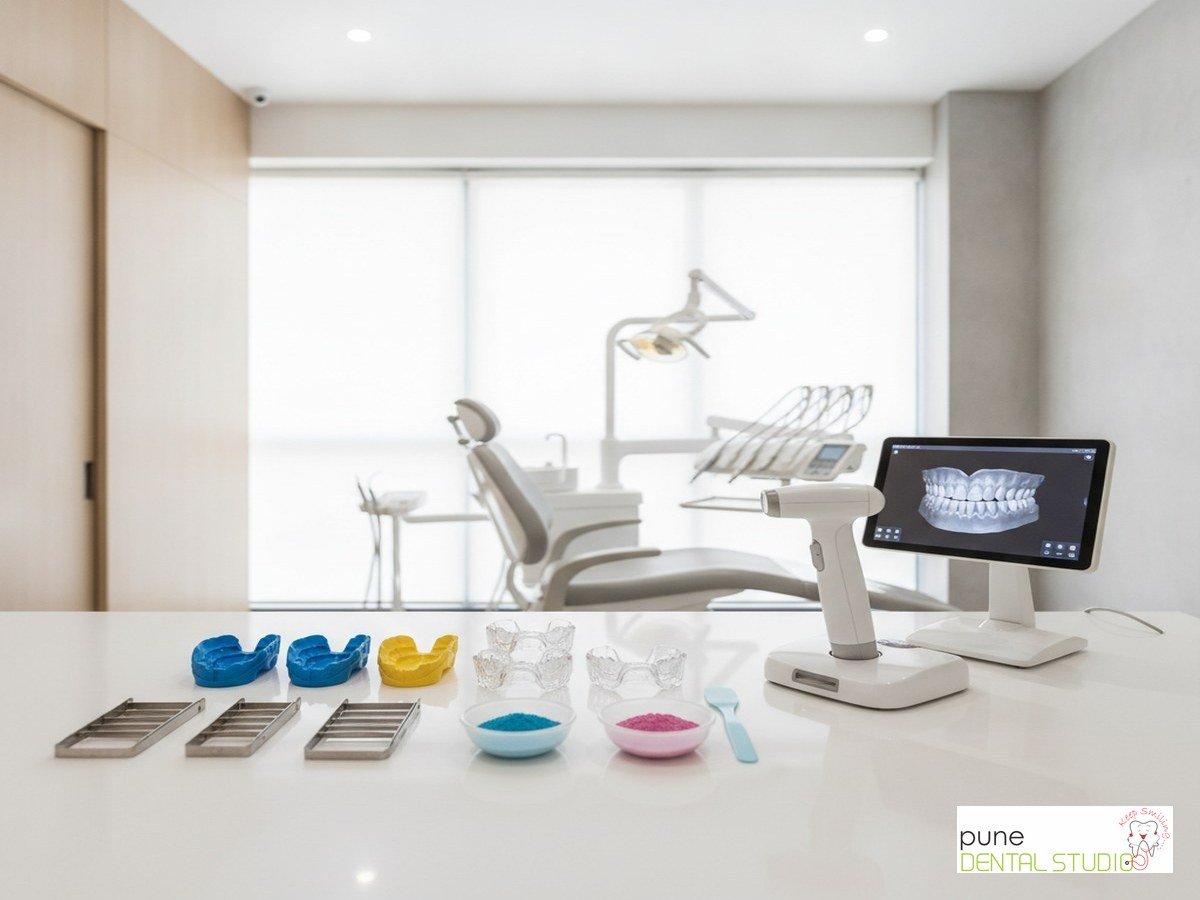
Impression trays are exactly what they sound like: small, U-shaped containers filled with impression material (usually alginate or putty). You bite into them, hold still for 30–60 seconds, and the material hardens around your teeth and gums. The dentist then removes the tray and sends it to a lab, where a technician pours plaster into the mold to create a physical model of your mouth.
Why do some clinics still use them? Honestly, habit and cost. Physical impression trays are cheap to produce, require no software training, and they work–they’ve worked for over a century. Many dentists learned on them, many labs still prefer receiving physical models, and the upfront investment in digital scanning equipment is significant.
But "it works" doesn’t mean "it’s the best option."
The Real Problems with Impression Trays
The gag reflex is real. When that tray sits in your mouth, it’s triggering the soft palate and back of your throat. For people with sensitive gag reflexes, this can be genuinely distressing. I’ve had patients who needed multiple attempts, which only made their anxiety worse.
Accuracy depends on your cooperation. If you move, swallow, or tense up during the 30–60 seconds, the impression can distort. Teeth that are slightly tilted or gums that are inflamed can shift the impression’s accuracy by millimeters–and in restorative dentistry, millimeters matter.
It’s messy and uncomfortable. The material tastes unpleasant, feels thick in your mouth, and if you’re claustrophobic or anxious, having something solid filling your entire mouth can feel suffocating.
Shipping and storage add time. The physical model has to be packaged, shipped to the lab, and handled by multiple people. If it gets damaged in transit, you’re starting over.
How Digital Intraoral Scanning Works
The Technology
A digital intraoral scanner is a small, handheld wand about the size of an electric toothbrush head. It uses structured light technology (essentially safe, visible light patterns) to capture thousands of images per second as I move it around your mouth. These images are stitched together by software into a precise, three-dimensional digital model of your teeth, gums, and bite.
The entire process takes 2–3 minutes. No paste. No gagging. No holding your breath.
What Happens Next
Once the scan is complete, that digital file is instantly available. I can show it to you on the monitor in real time–you can see your own mouth in 3D, zoom in on specific teeth, and understand exactly what we’re planning to do. If you’re getting a crown, a bridge, or aligners, you can actually see a preview of the result before we even start treatment.
The file is then sent directly to the lab via secure cloud connection. No shipping delays. No risk of damage. The lab technician receives a perfect digital model and can begin work immediately.
The Real Accuracy Difference
Here’s where it gets interesting from a clinical standpoint.
Traditional impression trays rely on the material setting evenly and your mouth staying perfectly still. Even tiny movements–a slight jaw shift, a swallow, a tongue movement–can create distortions. Labs then have to interpret these distortions and make assumptions about what the original anatomy was supposed to be.
Digital scanning captures your mouth’s geometry with micron-level precision. The software automatically detects and corrects for minor inconsistencies. If there’s a gap in the scan, it can be retaken in seconds. The final model sent to the lab is objectively more accurate.
This matters because:
- Crowns and bridges fit better. Better fit means less adjustment needed at delivery, less sensitivity, and longer-term success.
- Aligners track your teeth more predictably. For invisible braces, precision is everything. A slightly inaccurate impression can mean your aligners don’t track properly, and you end up with teeth that don’t move the way they should.
- Implant planning is safer. When we’re planning implant placement, we need to know the exact bone contours. Digital scans give us that information without guesswork.
Why We Still See Impression Trays in Some Clinics
I want to be fair here. There are legitimate reasons why some dentists haven’t switched:
Cost. A high-quality intraoral scanner is a major upfront investment, and for a small practice that’s a big decision. Some clinics also use older lab partners who prefer physical models and would need to retrain or switch labs.
Workflow inertia. If a dentist has been using impression trays for 20 years and it’s been working fine, the motivation to change isn’t always there–especially if their patients aren’t asking for it.
Lab compatibility. Not all labs have digital workflows yet. Some smaller labs still work primarily with physical models. A dentist might want to use digital scanning but can’t if their preferred lab isn’t equipped to receive digital files.
Specific clinical situations. In rare cases–like when a patient has severe gum inflammation or active bleeding–a physical impression might actually be more practical than trying to get a clean digital scan.
But these are exceptions, not the rule. The trend across modern dentistry is clear: digital scanning is becoming standard.
The Patient Experience: Why It Actually Matters
Let me be honest about what I hear from patients after their first digital scan:
"That’s it? I thought you were going to do something in my mouth."
"I didn’t gag once."
"Can I see my teeth on that screen again?"
For people with dental anxiety, this shift is transformative. You’re not fighting a reflex. You’re not enduring discomfort. You’re actively participating in understanding your own treatment plan.
At Pune Dental Studio, we’ve deliberately built our entire experience around this principle–removing unnecessary sources of stress and replacing them with transparency and control. The digital scanner is part of that philosophy, but it’s not the whole story. We also use noise-cancelling headphones, aromatherapy, warm lighting, and a completely unhurried approach to consultations. The goal is to make dental care feel like something you’re choosing to do for yourself, not something you’re enduring.
Accuracy Meets Comfort: The Best of Both Worlds
Here’s what I want you to take away:
Digital scanning isn’t just a comfort upgrade (though it absolutely is). It’s also a clinical upgrade. You get a more accurate model of your mouth, faster turnaround times, and a treatment plan you can actually see and understand before we begin.
If your dentist is still using impression trays and you’re wondering whether to ask about digital scanning–ask. It’s a fair question, and the answer matters. If they have a scanner, great. If they don’t, it’s worth understanding why, and whether switching is something they’re open to.
At our clinic in Baner, every patient gets a digital scan as part of their initial consultation. It’s not an upsell or an optional upgrade. It’s how we practice dentistry now. And I genuinely believe it’s made a difference in how patients experience their care.
Common Questions About Digital Scanning
Does it work for everyone? Yes. The only rare exception is if someone has severe gum inflammation or active bleeding, in which case we might wait a few days for the gums to settle. But for the vast majority of patients, it works beautifully on the first try.
Is the light safe for my eyes? Completely safe. The light is visible spectrum (similar to what you’d see in a camera flash) and very low intensity. It’s nowhere near the power of dental X-rays or UV light.
Can the digital file be hacked or shared without my permission? Our files are stored on secure, encrypted servers with the same privacy protections as medical records. Your data is yours, and it’s protected under the same privacy laws that govern any other health information.
What if I want a copy of my digital scan? Absolutely. You can request your scan file at any time, and we’ll provide it. It’s your mouth, your data.
Does digital scanning cost more? Not at Pune Dental Studio. We’ve built the cost of digital scanning into our standard treatment fees. You’re not paying extra for better accuracy and comfort–it’s simply how we work.
The Bigger Picture
Dentistry is changing. Technology is making procedures faster, more accurate, and less stressful. But the real shift isn’t about the gadgets–it’s about dentists asking themselves: "How can I make this better for the person sitting in my chair?"
When we chose to invest in digital scanning, it wasn’t just because it’s newer. It was because we listened to what patients were telling us: they don’t like gagging, they want to understand their treatment before it happens, and they want their dentist to use the best tools available.
If you’re in Aundh, Baner, or anywhere in Pune and you’ve been putting off dental work because the thought of impression trays makes you anxious–I want you to know there’s a better way. Come in for a consultation. See your own mouth in 3D. Ask questions. And let us show you that modern dentistry doesn’t have to feel like something you’re enduring.
You deserve care that respects your comfort and your intelligence. That’s what we’re building here.
Ready to experience digital scanning for yourself? Call us at +91 98811 92594 or visit us at Office No 102, 1st floor, The Mint, Off Baner Road, Opposite Kapil Mallhar Society, Baner, Pune. We’ll take care of you–the way you deserve to be taken care of.
Updated on 8 Oct 2026
Dentistry that feels like a deep breath.
See it for yourself – your first visit is a conversation, not a commitment.
Book a Visit