
AI in Dentistry: Is Your Dentist in Baner Ready? A Clear Guide
The Question I Hear Most Often
"Dr. Khade, I’ve read that AI is coming to dentistry. Does that mean a robot will be treating my teeth? Should I be worried?"
I hear this almost every week now, and I get it. The idea of artificial intelligence in healthcare can feel a bit sci-fi, maybe even unsettling. But here’s what I’ve learned over nearly two decades of practice: AI isn’t about replacing dentists. It’s about giving us better eyes, steadier hands, and the ability to catch problems earlier than we ever could before.
The real question isn’t whether AI is coming to dentistry. It’s already here. The real question is: Is your dentist ready to use it well?
Let me walk you through what’s actually happening, what it means for your care, and why I’ve chosen to embrace these tools at Pune Dental Studio.
What AI Actually Does in a Dental Chair
When most people think of AI in dentistry, they imagine something futuristic and vaguely threatening. The reality is much more practical, and honestly, much more helpful.
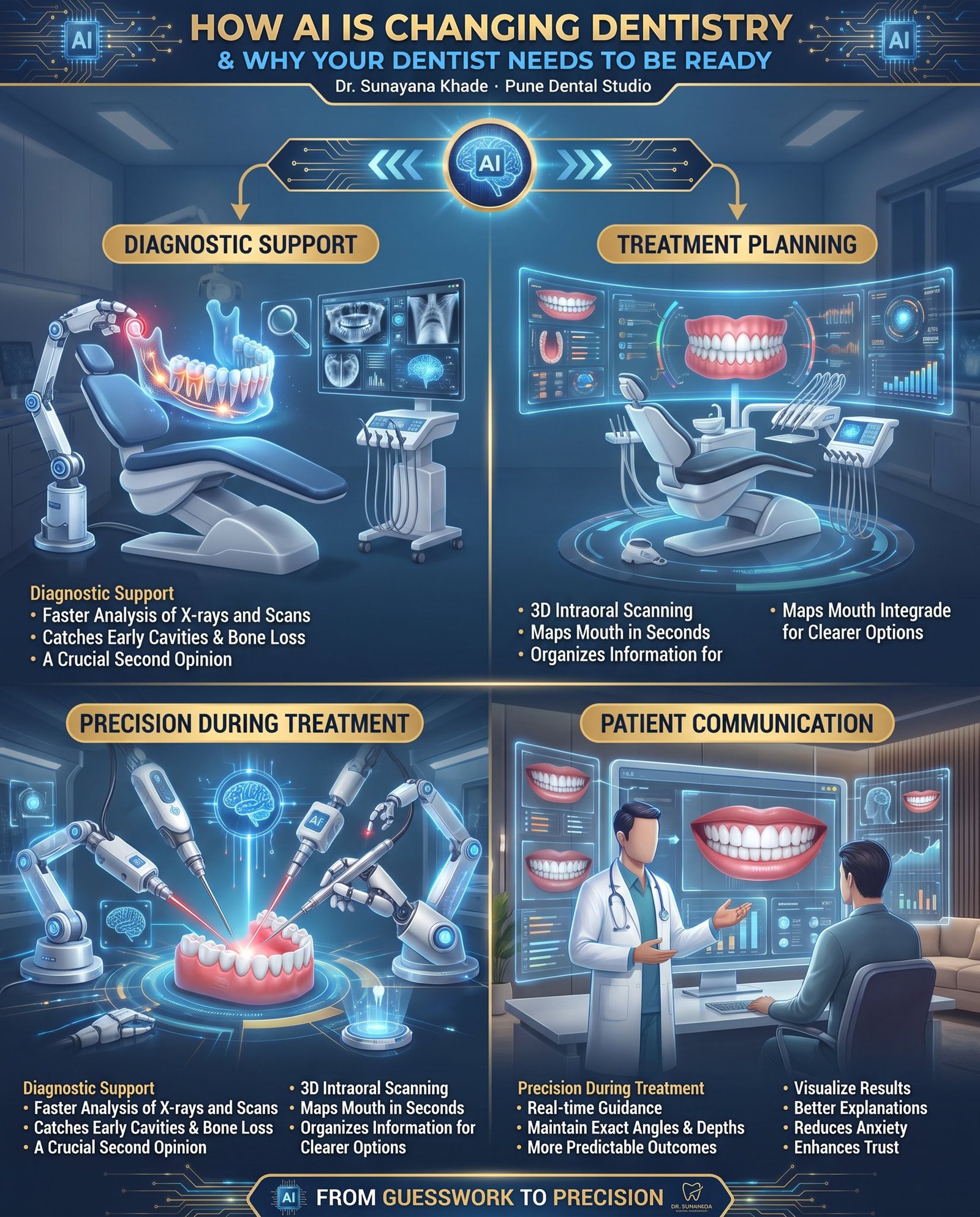
AI in dentistry works in three main ways.
Diagnostic Support. AI algorithms can analyze X-rays and scans faster and sometimes catch things a tired human eye might miss. Early cavities, bone loss patterns, signs of disease. I use this as a second opinion, not a replacement for my judgment. The technology flags potential issues; I verify and decide.
Treatment Planning. Digital scanning and 3D imaging, which we use here at the studio, allow AI to map your entire mouth in seconds and suggest optimal treatment pathways. This isn’t the machine deciding what you need. It’s the machine organizing information so I can explain your options clearly and honestly.
Precision During Treatment. Some procedures benefit from AI-guided tools that help maintain exact angles, depths, and positioning. Root canals, implant placement, and orthodontic adjustments all become more predictable.
None of this removes the dentist. It removes guesswork.
Why Readiness Matters – And What It Means
Here’s where I need to be honest with you: not every dentist who has access to AI technology is actually ready to use it well.
Readiness means three things.
First, it means understanding the tool’s limits. AI is brilliant at pattern recognition, but it doesn’t understand your specific medical history, your anxiety, your budget, or your life. A dentist who is truly ready knows when to trust the AI and when to override it based on what they know about you.
Second, it means training. Using AI in dentistry isn’t like turning on a new app. It requires understanding how the technology works, what it can and can’t do, how to interpret its output, and how to integrate it into a workflow that still puts the patient first. I’ve invested time in learning these systems properly, not just clicking buttons.
Third, it means commitment to transparency. A ready dentist explains what the AI found, shows you the images, walks you through the logic, and gives you real choices. An unprepared dentist might use AI as a sales tool. "The machine says you need this" instead of as a diagnostic aid.
When I adopted 3D digital scanning at Pune Dental Studio, I didn’t do it because it was trendy. I did it because it actually reduces patient anxiety. No more gag-triggering impression trays. It gives me better information, and it lets me show you exactly what I’m seeing on a screen. That’s readiness.
The Real Benefits You’ll Notice
If your dentist is ready to use AI well, here’s what changes for you.
Faster, More Accurate Diagnosis. You spend less time in the chair, and the treatment plan is based on clearer information. No more "Let’s wait and see" when the AI can flag a cavity at its earliest stage.
Better Explanations. When I can show you a 3D model of your tooth and explain exactly what needs to happen, you feel more in control. You’re not just trusting my word; you’re seeing it yourself.
More Predictable Outcomes. Whether it’s a crown, an implant, or orthodontic work, AI-assisted planning means fewer surprises and better long-term results.
Reduced Anxiety. This one matters to me personally. When patients can see what’s happening in real time, when they understand the plan, when the process feels less mysterious, anxiety drops. That’s not just nice; it’s medically important.
Personalized Care. AI helps me organize vast amounts of information about your mouth, your history, and your preferences. That means treatment is tailored to you, not a one-size-fits-all protocol.
What AI Cannot and Should Not Do
I want to be equally clear about what AI is not in dentistry.
It’s not a substitute for clinical judgment. A machine can flag that your bite looks asymmetrical, but only a trained dentist can decide whether that matters for your specific situation.
It’s not a reason to rush treatment. Some dentists might use AI to justify pushing patients toward expensive procedures. A ready dentist uses AI to be more conservative and more honest.
It’s not a replacement for the relationship between you and your dentist. You need someone who knows your history, listens to your concerns, and makes decisions with your best interests in mind. Not someone who outsources that thinking to an algorithm.
And it’s absolutely not an excuse to depersonalize care. If anything, good AI use frees up time for me to spend with you, explaining, listening, and building trust.
How We Use AI at Pune Dental Studio
I’ve integrated AI tools into our practice because they align with what we’ve always believed: that dentistry should be precise, transparent, and centered on reducing fear.
Our 3D intraoral scanning system is a perfect example. It captures your mouth in stunning detail without the discomfort of traditional trays. That data feeds into treatment planning software that helps me visualize outcomes. Whether we’re designing a smile makeover, planning implant placement, or mapping orthodontic movement.
I use AI-assisted diagnostic tools to review X-rays and scans, but I’m always the final decision-maker. The technology tells me what to look for; my experience tells me what it means.
And critically, I explain everything to you. You see what the AI found. You understand why I’m recommending what I’m recommending. You’re never left wondering whether a recommendation came from clinical need or from a machine’s suggestion.
That’s what readiness looks like in practice.
The Bigger Picture: Why This Matters for Your Health
Dentistry is moving toward precision medicine. That’s not hype; it’s reality. The same way your cardiologist might use AI to interpret your ECG, your dentist increasingly will use AI to interpret your mouth.
The question for you, as a patient, is simple: Is your dentist keeping up?
A dentist who is ready to adopt AI thoughtfully is signaling something important. They’re saying: "I care enough about your care to invest in better tools. I’m willing to learn. I’m not afraid of technology; I’m using it to serve you better."
Conversely, a dentist who dismisses AI entirely or uses it without transparency is signaling something else. Either they’re not investing in their practice, or they’re not thinking carefully about how to integrate new tools responsibly.
Neither is reassuring.
FAQ
Q: Will AI replace dentists? No. AI will replace bad dentistry. The kind that’s slow, imprecise, and based on guesswork. Good dentistry, the kind that requires judgment, empathy, and years of training, is irreplaceable. What will change is that good dentists will use AI to be even better.
Q: Is AI treatment more expensive? Not necessarily. At Pune Dental Studio, we share all pricing in writing before treatment begins. AI tools sometimes reduce costs because they help us avoid unnecessary procedures. Sometimes they add value in the form of better outcomes, and that’s reflected in pricing. But there are no hidden charges or AI upsells.
Q: What if I’m uncomfortable with AI in my treatment? That’s completely valid, and I want to know. Every patient has the right to understand their care and to opt out of any tool they’re not comfortable with. That said, I’d encourage you to ask questions first. Often, once you understand what the technology does, concerns ease.
Q: How do I know if my dentist is ready to use AI well? Ask. Ask whether they use AI, what for, how they’re trained, and how they explain it to patients. A ready dentist will answer clearly and honestly. They’ll show you the technology. They won’t oversell it or hide it. They’ll explain how it serves you, not how it serves their practice.
A Warm Invitation
If you’re curious about how AI is showing up in modern dentistry, or if you’re wondering whether your current dental care is using the best available tools, I’d love to talk with you.
At Pune Dental Studio, we’ve built our practice around a simple idea: that dentistry should be precise, transparent, and centered on reducing fear. AI tools help us do that better. But they’re never the point. You are.
Whether you’re dealing with dental anxiety, considering a cosmetic procedure, or just want to know what modern dental care actually looks like, reach out. We’re here in Baner, and we’re ready to show you what thoughtful, technology-enabled dentistry feels like.
You can call or WhatsApp us at +91 98811 92594, or visit us at punedentalstudio.com. I’m here to answer your questions. No pressure, no sales pitch, just honest conversation about your teeth and your health.
Because at the end of the day, the best technology in the world only matters if it’s in the hands of a dentist who genuinely cares about your wellbeing. And that’s what I’m here for.
Looking forward to meeting you.
Dr. Sunayana Khade Pune Dental Studio, Baner
Updated on 19 Oct 2026
Dentistry that feels like a deep breath.
See it for yourself – your first visit is a conversation, not a commitment.
Book a Visit