How Digital Technology and AI Are Transforming Dental Practice in 2026 – 2027
I remember the first time I held a traditional impression tray in my hands as a dental student. Pink, gooey, uncomfortable. My patient gagged. I felt helpless. That was over 20 years ago, and honestly, I thought that was just how dentistry had to be.
Then everything changed.
In the last few years, I’ve watched technology completely reshape what happens in my operatory. Not in a flashy, marketing-heavy way. In a way that actually matters to the person sitting in my chair. And this week, I’ve been reading about how these tools are spreading across the profession, and I wanted to share what I’m seeing in my own practice and what it means for you.
The Shift From Guesswork to Precision
Let me be honest: traditional dentistry relied on a lot of interpretation. A dentist would take an X-ray, look at it, and make a judgment call. A patient would describe their pain, and we’d do our best to figure out what was happening. But there was always a gap between what we could see and what was actually going on.
Digital diagnostics have closed that gap in ways I never expected.
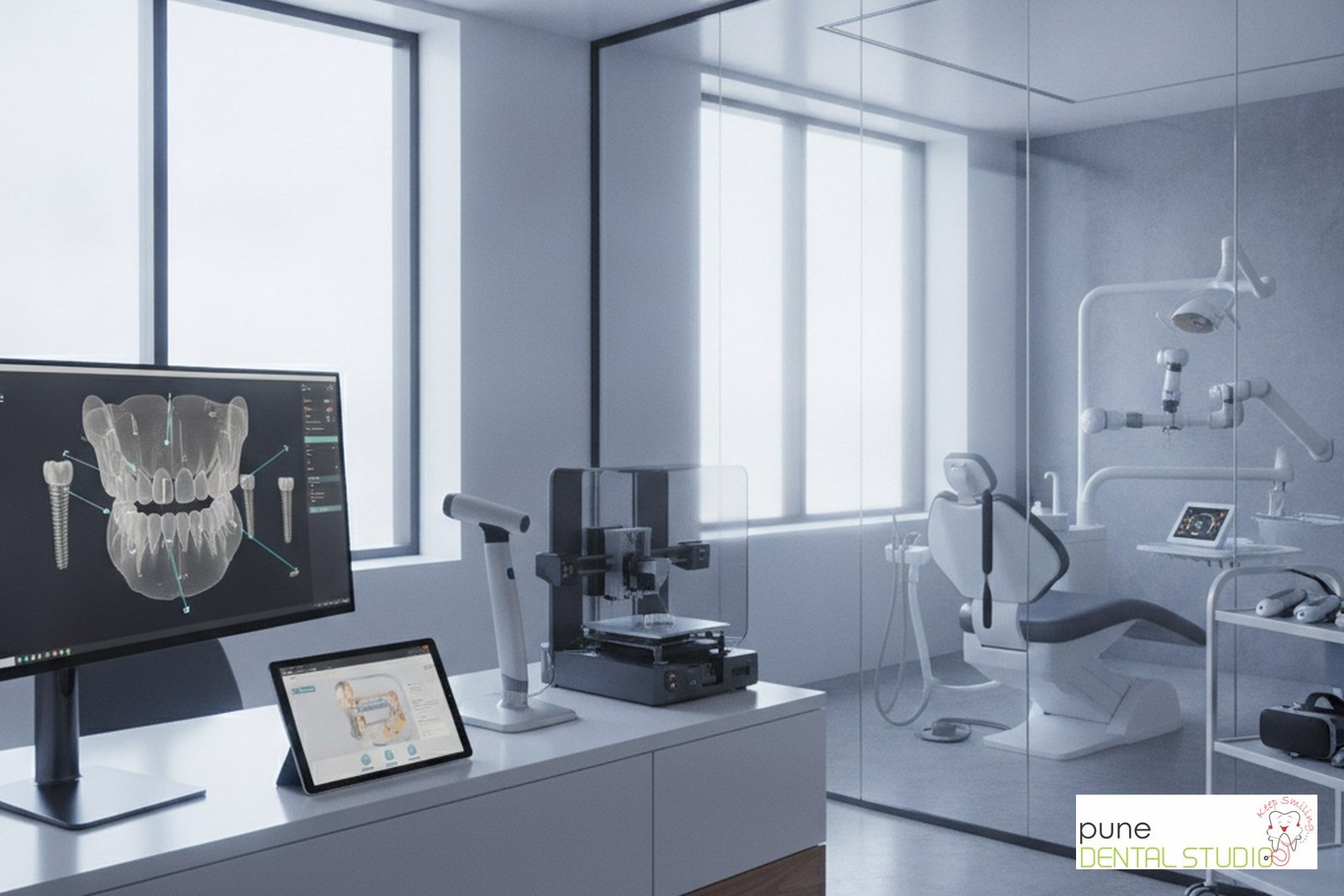
According to recent reporting from Dentistry.co.uk, digital diagnostics are now transforming patient education by giving dentists and patients a shared visual language. Instead of me pointing at a grainy X-ray and saying, "You have a cavity here," I can now show you a 3D reconstruction of your tooth, zoom in on the exact spot, and let you see exactly what I’m seeing. You’re not taking my word for it anymore. You’re seeing the evidence.
At Pune Dental Studio, we’ve moved entirely to live 3D intraoral scanning. Those old impression trays? Gone. Instead, a small wand moves around your mouth, capturing precise digital data that creates a perfect 3D model of your teeth and gums. No gagging. No waiting for results. Just clarity.
AI is Changing How We Plan Treatment
Here’s something that still amazes me: AI tools are now helping dentists plan complex cases with a precision that would have taken me hours to calculate manually.
Take orthodontics, for example. When I’m planning invisible aligners or braces, AI can now predict how your teeth will move, show you a preview of your final smile before treatment even starts, and help me adjust the plan in real time. It’s not replacing my judgment. It’s enhancing it. I’m making better decisions because I have better information.
The same is true for implant planning. Before placing an implant, I need to know exactly where the bone is, how much bone you have, and where the nerves are. A 3D scan with AI analysis gives me that information instantly. The surgery becomes safer, faster, and more predictable.
Patient Education Has Changed Everything
One of the biggest shifts I’ve noticed is in how patients understand their own treatment.
When I show someone a 3D model of their mouth on a screen, something clicks. Suddenly, they’re not just hearing about a problem. They’re seeing it. They’re understanding why treatment matters. And they’re making informed decisions instead of just trusting me blindly.
This matters more than you’d think. Patients who understand their treatment are more likely to follow aftercare instructions. They’re less anxious because they know exactly what’s going to happen. And they’re more satisfied with results because there are no surprises.
At our clinic, we’ve built this into our entire consultation process. Before we even talk about cost or scheduling, you see your mouth. You see what needs to be done. And you see what the result will look like. That transparency changes everything.
The Reality Check: Technology Isn’t Magic
Here’s what I need to say clearly: technology is a tool, not a replacement for clinical skill.
I’ve noticed something in my practice over the years. Patients sometimes assume that more technology means better care. But I’ve seen dentists with the fanciest equipment deliver mediocre results, and I’ve seen experienced dentists with basic tools do extraordinary work.
What matters is how the technology is used. A 3D scan in the hands of someone who doesn’t know how to interpret it is just a fancy picture. AI planning software used by someone without clinical judgment can lead you down the wrong path.
The real transformation happens when technology amplifies what a skilled, experienced dentist can do. That’s what we focus on at Pune Dental Studio. We’ve invested in the best digital tools available, but only because we have the training and experience to use them properly.
What This Means for Your Dental Anxiety
If you’ve been avoiding the dentist because of anxiety, digital technology is genuinely good news for you.
Over my 20+ years of practice, I’ve learned that dental anxiety isn’t a character flaw. It’s a signal that your nervous system needs a different kind of environment. Digital tools help create that environment in several ways.
First, there’s no guesswork. You know exactly what’s happening because you can see it. Second, many procedures are faster because the dentist has perfect information from the start. Third, treatments like 3D scanning eliminate some of the most anxiety-triggering parts of traditional dentistry, like impression trays.
At our clinic, we’ve combined digital technology with a sensory-calm environment: noise-cancelling headphones, aromatherapy, warm lighting, and a living green wall. When you add that to the precision of digital tools, something shifts. Patients who thought they’d never get dental work done suddenly find it manageable.
The Bigger Picture: AI and Diagnostics
There’s been a lot of buzz about AI in dentistry lately. Some of it’s hype. Some of it is genuinely useful.
Right now, AI is best at pattern recognition. It can analyze thousands of X-rays and identify subtle signs of decay, bone loss, or other problems that a human eye might miss. It can flag cases that need urgent attention. It can help with treatment planning.
What AI can’t do is replace clinical judgment. It can’t understand the full context of your health. It can’t make the complex decisions that require experience, intuition, and human empathy.
I think of AI as a second set of eyes. A really good second set of eyes that never gets tired and has seen millions of cases. But it’s still working alongside me, not instead of me.
Why Transparency Matters More Than Ever
Here’s something I’ve noticed over the years: patients feel most confident when they know exactly what something costs before we even start.
Digital technology has made this easier. When I can show you exactly what treatment you need, I can give you an exact price. No surprises. No hidden costs. Just clarity.
At Pune Dental Studio, we provide all pricing in writing before any procedure begins. We’re not up-selling you on treatments you don’t need. We’re recommending what your mouth actually needs, and we’re being transparent about what it costs.
This is where I see the biggest difference between clinics that truly embrace patient-centered care and those that just use technology as a marketing tool.
The Future is Here, and It’s Personal
When I think about where dentistry is heading, I’m genuinely excited.
Digital technology and AI aren’t making dentistry cold or impersonal. They’re doing the opposite. They’re giving dentists better tools to understand each patient’s unique situation. They’re helping us communicate more clearly. They’re making treatment faster, safer, and less scary.
But the human element is still what matters most. Your dentist’s experience, judgment, and empathy. The relationship you build with your dental team. The trust that allows you to relax in the chair.
Technology amplifies all of that. It doesn’t replace it.
Frequently Asked Questions
Q: Is 3D scanning safe? A: Yes. 3D intraoral scanners use visible light, not radiation. There’s no X-ray exposure. It’s completely safe, even for children and pregnant patients.
Q: Will AI replace my dentist? A: No. AI is a tool that helps your dentist make better decisions. It can’t examine your mouth, can’t understand your full health history, and can’t make complex clinical judgments. Your dentist is irreplaceable.
Q: Does digital technology cost more? A: Not necessarily. At Pune Dental Studio, our pricing is based on the treatment you need, not the technology we use. In fact, digital tools often make treatment more efficient, which can actually reduce costs.
Q: How do I know if my dentist is using technology properly? A: Ask questions. A good dentist will explain how they’re using technology and why. They’ll show you what they’re seeing. They’ll be transparent about costs. And they’ll never pressure you into unnecessary treatment.
Q: What if I’m still anxious about dental work? A: Talk to your dentist about it. At our clinic, we’ve designed our entire environment to help anxious patients feel comfortable. Digital tools eliminate some anxiety-triggering steps. And we take your concerns seriously.
Let’s Talk About Your Smile
If you’ve been putting off dental work because you were worried about cost, pain, or the experience itself, I want you to know that things have changed. Technology has made dentistry more transparent, more comfortable, and more predictable.
But the most important thing is still the relationship between you and your dentist.
If you’d like to see how digital technology can help with your specific situation, I’d love to talk with you. We offer digital consultations where you can see your mouth in 3D before you even come in. No obligation. No pressure. Just clarity.
You can reach us at +91 98811 92594 or WhatsApp us anytime. Or visit us at 1st floor, The Mint, Office No 102, Off Baner Rd, opposite Kapil Mallhar Society, Pune.
I’m here to help.
Sources:
Updated on 24 Nov 2026
Dentistry that feels like a deep breath.
See it for yourself – your first visit is a conversation, not a commitment.
Book a Visit