Orthodontist in Baner: What to Expect, How Much It Costs, and Why Timing Matters
Most People Walk In With the Same Question
"Can I really straighten my teeth without anyone noticing?" That worry is completely valid. I’ve been practicing dentistry since 2006, and I’ve watched invisible aligners evolve from a luxury option into a genuinely effective treatment that works for most people who want a straighter smile without the visibility of traditional braces.
But here’s what I’ve learned over my 20+ years of practice: the choice between braces and aligners isn’t just about vanity. It’s about finding a treatment that fits your life, your bite, and your commitment level. And honestly, both work. The difference is in the details.
Let me walk you through what I actually see in my practice, based on real patient experiences.
How Orthodontic Treatment Actually Works
When you sit down for a consultation, the first thing I do is listen to what bothers you about your smile. Then I look at three things: how your teeth are positioned, how your bite closes, and whether there are any underlying jaw or gum issues that need attention first.
Orthodontic treatment moves teeth by applying gentle, consistent pressure over time. Braces use brackets and wires. Aligners use a series of custom-made plastic trays that gradually shift your teeth into position. Both methods work by the same biological principle: your bone remodels as teeth move.
The timeline varies. In my practice, treatment typically takes anywhere from 6 to 18 months, depending on how much movement your teeth need. Some patients come in with minor crowding and finish in six months. Others have significant bite problems and take two years.
Here’s what matters most: consistency. This is where I see the biggest difference between patients who succeed and those who don’t. If you choose aligners, you need to wear them 20 to 22 hours a day. If you choose braces, you need to show up for appointments and follow care instructions.
I’ve seen patients choose aligners for speed but end up taking longer because they weren’t consistent about wearing them. Conversely, I’ve seen patients with braces who skipped appointments and delayed their results just as much. The tool doesn’t matter as much as the commitment.
Clear Aligners: What You’re Actually Signing Up For
Most people walk into my chair asking about invisible aligners because they’ve seen them advertised everywhere. The appeal is obvious: no one can see them, they’re removable, and the idea of a straighter smile without visible brackets sounds perfect.
Here’s what I see happen in my practice: treatment typically takes 6 to 18 months, depending on your starting point. You’ll receive a series of trays, usually changing to a new one every one to two weeks. Each tray is slightly different, moving your teeth in tiny increments.
The commitment is real, though. You need to wear them 20 to 22 hours a day. That means they come out only for eating, drinking (except water), and brushing. I know this sounds restrictive, but I’ve seen patients actually appreciate this because it naturally limits snacking and keeps their eating habits more structured.
One of the biggest advantages I see is how aligners fit into your life. You can remove them for special occasions, though I recommend keeping that to a minimum. You can brush and floss normally without navigating wires and brackets. And there’s no emergency wire breakage at 8 PM on a Sunday.
But here’s what I’ve learned from watching hundreds of patients over my 20+ years of practice: the ones who succeed are the ones who treat their aligners like a commitment, not a convenience. I’ve seen patients who wore them 16 hours a day and ended up adding six months to their treatment because their teeth moved more slowly. I’ve also seen patients who lost trays, didn’t order replacements, and then stopped treatment entirely.
One thing I notice: patients often assume mail-order aligner kits are the same as custom-made ones from a dental practice. I see patients come in after trying those kits, and honestly, the results are often disappointing. I’ve also seen patients end up with worse bites after DIY treatment because the aligners were moving their teeth without considering how their bite closes.
At Pune Dental Studio, we use digital 3D scanning to map your mouth precisely. You can actually see a preview of your final result before we even start. That transparency matters. You know exactly what you’re getting into.
Metal and Ceramic Braces: The Traditional Path
Braces get a lot of bad press. It’s almost become shorthand for "the worst dental experience ever." But here’s what I’ve learned from completing thousands of orthodontic cases over my 20+ years of practice: the anticipation is almost always worse than the reality.
I’ve seen patients walk in terrified and walk out relieved. And here’s what I’ve noticed: patients who get their braces on feel a weight lift. There’s something about taking action that reduces anxiety.
Metal braces are durable and effective. Ceramic braces blend in better because they’re tooth-coloured, though they’re slightly more fragile. Both work by the same principle: the wire applies pressure, and your bone gradually remodels.
The commitment is different from aligners. You can’t remove braces, so you need to be disciplined about cleaning around them. You’ll have regular appointments to tighten the wire. You’ll need to avoid certain foods that can damage brackets. And yes, there’s a learning curve with how to brush and floss effectively.
But here’s something I’ve noticed over the years: patients who get braces often feel more secure. The treatment is happening whether they think about it or not. There’s no temptation to skip wearing them or lose a tray.
The Real Timeline: What to Expect Month by Month
I see patients come in thinking orthodontic treatment is a straight line from start to finish. It’s not quite that simple.
In the first month, your teeth and gums will feel tender. Your mouth is adjusting to the pressure. I recommend soft foods and over-the-counter pain relief if needed. Most patients tell me the discomfort is much less than they expected.
Months two through four, you’ll start to see visible movement. This is when many patients feel motivated. Their teeth are actually shifting. The novelty of braces or aligners wears off, and it becomes part of your routine.
Months five through twelve, the pace can feel slower. This is normal. Teeth don’t move in a straight line. Sometimes they need to move sideways before they can move forward. This is where I see patients lose motivation. They think something’s wrong, but usually, we’re right on track.
The final months are about refinement. We’re making fine adjustments to your bite and making sure your teeth are perfectly aligned. This phase can take longer than you’d expect because precision matters.
After braces come off or aligners are finished, retention is critical. I see patients skip this step, and their teeth gradually shift back. You’ll need to wear a retainer, usually every night for the first year, then several nights a week long-term.
Cost and Payment: What You’ll Actually Spend
Most people walk into my chair with the same question I hear hundreds of times: "How much is this going to cost?" That anxiety is completely valid. Orthodontic treatment is an investment.
At Pune Dental Studio, we’re transparent about pricing from the start. Metal braces range from 35,000 to 70,000 rupees. Clear aligners start from 80,000 rupees. These are all-inclusive costs that cover your entire treatment, not just the initial setup.
Here’s something I’ve noticed over the years: patients feel most confident when they know exactly what something costs before we even start. We provide an itemised treatment plan in writing. No surprises at checkout.
We also offer EMI and flexible payment options, because I’ve talked to hundreds of people who delayed dental care because they were terrified of getting hit with a massive bill they didn’t expect. That shouldn’t be a barrier to straightening your teeth.
Why Gum Health Comes First
Here’s something I need to be direct about: if you have gum disease, we won’t start orthodontic treatment until we’ve treated it first.
I see patients come in excited about straightening their teeth, only to discover they have gingivitis or periodontal disease. Moving teeth through diseased gums is like building a house on unstable ground. It doesn’t end well.
The good news is that gum disease is treatable. Deep scaling, improved home care, and sometimes additional periodontal treatment can reverse early-stage disease. Once your gums are healthy, we can move forward with confidence.
Common Mistakes I See
Over my 20+ years of practice, I’ve learned that it isn’t a character flaw to make mistakes during orthodontic treatment. But some mistakes are more common than others.
The biggest one: not wearing aligners consistently. I’ve seen patients add six months to their treatment because they wore their aligners 18 hours a day instead of 22. Teeth move slower when pressure is inconsistent.
The second: poor oral hygiene during treatment. I’ve seen patients finish braces only to discover they have cavities underneath. Brush and floss diligently, especially around brackets.
The third: skipping the retainer phase. I see patients lose teeth back to their original position within months of finishing treatment. A retainer isn’t optional. It’s the final, crucial phase.
The fourth: not following dietary restrictions with braces. Sticky foods, hard candies, and crunchy snacks can break brackets. I know it’s annoying, but it matters.
What Happens at Your First Consultation
When you come in for a consultation, you’re not just getting a quick look-over. I take time to actually hear what you want and what concerns you.
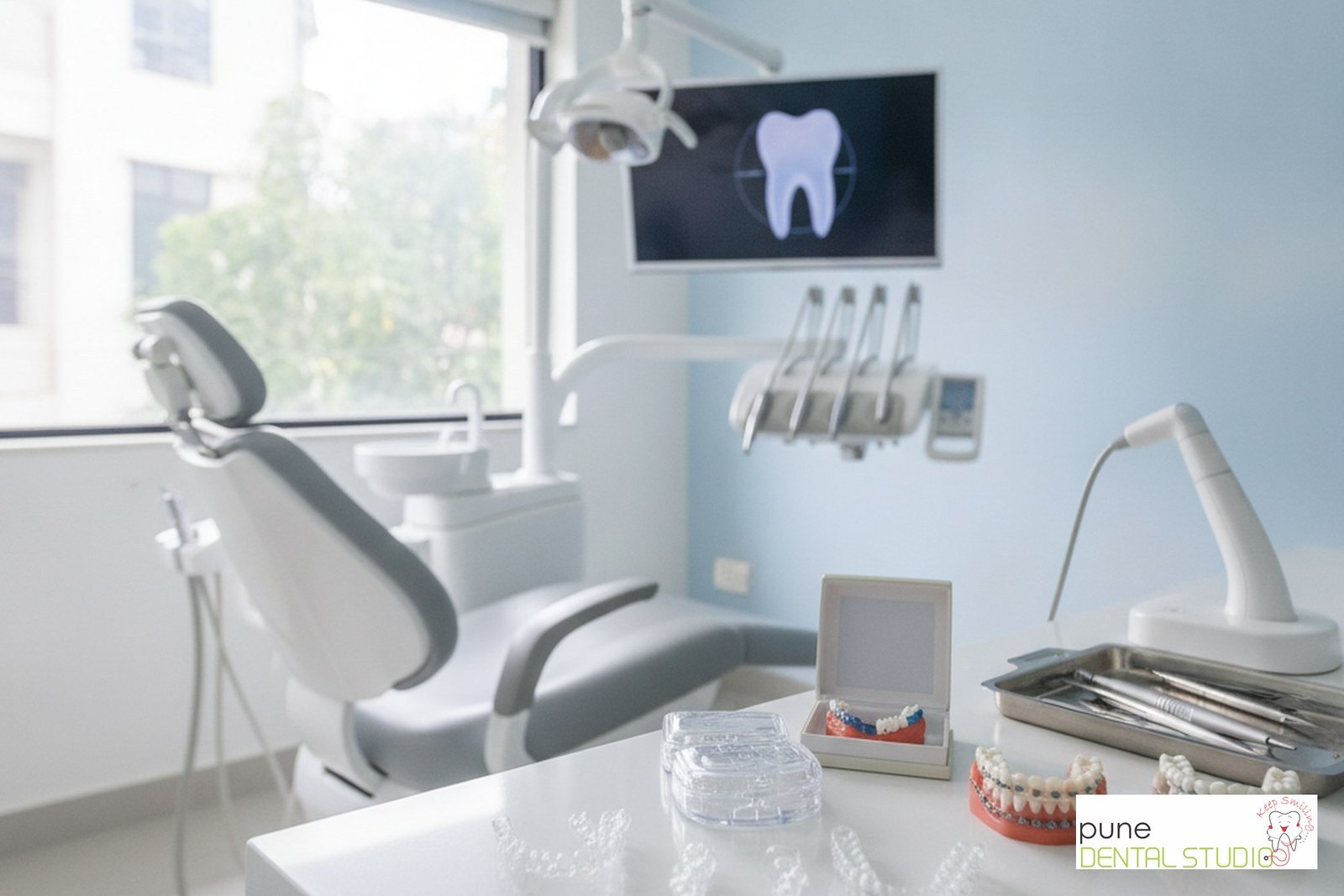
First, I’ll examine your teeth and bite. I’ll take digital X-rays and 3D scans. Then I’ll walk you through what I see on the screen. At Pune Dental Studio, we use live chairside scan walkthroughs, so you can see exactly what needs to happen.
I’ll explain your options: braces, aligners, or sometimes a combination approach. I’ll be honest about timeline and cost. I’ll answer your questions without pressure.
Many of my patients tell me they’re surprised at how much time I take to actually hear what they’re saying. That’s intentional. You’re making a significant commitment. You deserve to feel heard and understood.
Questions I Hear Most Often
How long does treatment actually take?
Typically, 6 to 18 months. Minor crowding might finish in six months. Significant bite problems might take two years. The timeline depends on how much your teeth need to move and how consistently you follow treatment.
Will it hurt?
There’s tenderness, especially in the first week after braces are placed or when you start a new aligner tray. It’s not sharp pain, more like a dull ache. Over-the-counter pain relief helps. Most patients adjust within a week.
Can I eat normally with braces?
You’ll need to avoid sticky, hard, and crunchy foods. But you can eat most things if you’re careful. With aligners, you remove them to eat, so there are no dietary restrictions.
How often will I need appointments?
With braces, typically every four to six weeks. With aligners, every six to eight weeks. Regular appointments are important because we’re monitoring your progress and making adjustments.
What if I lose an aligner tray?
Contact us immediately. We can order a replacement, but there will be a small fee. This is why I recommend keeping your old trays as a backup.
Will my teeth shift back after treatment?
Yes, if you don’t wear a retainer. Teeth naturally want to return to their original position. A retainer prevents this. Wear it every night for the first year, then several nights a week long-term.
Is orthodontic treatment safe?
Yes, when done by a qualified orthodontist or dentist trained in orthodontics. Teeth can move safely with proper pressure and monitoring. Gum health and bone density are checked throughout treatment.
Why Timing Matters
I’ve heard this from patients in their 50s, 60s, and even 70s, usually with a mix of hope and resignation in their voice: "Isn’t it too late for me?"
Over my 20+ years practicing dentistry, I’ve seen some of the most rewarding transformations happen to patients who thought they’d missed their window. Age isn’t a barrier. What matters is gum health, bone density, and commitment.
But here’s what I’ve also noticed: people often delay because they’re not sure what the first step is. They assume it’s expensive. They assume it’ll take forever. They assume they’re too old.
None of those assumptions are necessarily true. A consultation is the first step. It’s a chance to understand your options without any pressure. At Pune Dental Studio, we offer digital consultations and 3D scanning starting from 500 rupees. That’s an affordable way to get clarity.
The Environment Matters More Than You’d Think
Over my 20+ years of practice, I’ve learned that dental anxiety isn’t a character flaw. It’s a signal that your nervous system needs a different kind of environment.
At Pune Dental Studio, we’ve designed our clinic specifically for people who are anxious about dental work. We use noise-cancelling headphones, aromatherapy, warm lighting, and a living green wall. We apply extra-strength topical numbing gel before any injection. We show you everything on a 3D screen before we start.
These aren’t luxuries. They’re necessities for people whose nervous systems are triggered by traditional dental settings. And if you’re considering orthodontic treatment, you’ll be spending significant time in that chair. The environment matters.
Getting Started
If you’re in Baner, Aundh, Balewadi, Pashan, or Wakad, and you’re thinking about straightening your teeth, the first step is simple: get a consultation.
Call us at +91 98811 92594 or visit punedentalstudio.com to book a visit. We’re open Monday to Saturday, 9:30 AM to 1 PM and 5 PM to 9 PM. Sundays by appointment.
I’ll examine your teeth, show you your options on a 3D screen, and give you an honest timeline and cost estimate. No pressure. No surprises. Just clarity.
After 20 years of practicing dentistry, I still remember my own nervousness before my first dental procedure. I get it. But I’ve also seen hundreds of people transform their confidence with orthodontic treatment. The anticipation is almost always worse than the reality.
Your smile is worth the investment. Let’s talk about how to make it happen.
FAQ
Q: Can I do orthodontic treatment if I have gum disease?
A: Not until we’ve treated the gum disease first. Healthy gums are essential for successful tooth movement.
Q: How much does orthodontic treatment cost at Pune Dental Studio?
A: Metal braces range from 35,000 to 70,000 rupees. Clear aligners start from 80,000 rupees. These are all-inclusive costs. We offer EMI and flexible payment options.
Q: How long does treatment take?
A: Typically 6 to 18 months, depending on how much movement your teeth need and how consistently you follow treatment.
Q: Will orthodontic treatment hurt?
A: There’s tenderness, especially in the first week, but not sharp pain. Most patients adjust within a week. Over-the-counter pain relief helps.
Q: Can I eat normally with braces?
A: You’ll need to avoid sticky, hard, and crunchy foods. With aligners, you remove them to eat, so there are no dietary restrictions.
Q: What happens after treatment ends?
A: You’ll wear a retainer to prevent your teeth from shifting back. Wear it every night for the first year, then several nights a week long-term.
Q: Am I too old for orthodontic treatment?
A: No. Age isn’t a barrier if you have healthy gums and good bone density. I’ve treated patients in their 60s and 70s with excellent results.
Q: How do I know if I need braces or aligners?
A: It depends on your specific bite, lifestyle, and commitment level. At your consultation, I’ll explain which option is best for your situation.
Ready to explore your options? Reach out to us at Pune Dental Studio in Baner. Call +91 98811 92594, email smile@punedentalstudio.com, or visit punedentalstudio.com to book your consultation. We’re here to answer your questions and help you take the first step toward the smile you’ve always wanted.
<div data-gs-seal="1" style="display:flex;flex-wrap:wrap;align-items:center;gap:0 16px;margin:28px 0 0;border-radius:16px;padding:18px;color:#fff;background-color:#0B1220;background:radial-gradient(120% 140% at 0% 0%,#312E81 0%,#0B1220 55%);font-family:Inter,Arial,sans-serif;line-height:1.4"><div style="flex:none;width:58px;height:58px;border-radius:50%;background:#0B1220;border:3px solid #4F46E5;margin:0 0 8px 0;box-shadow:0 0 24px rgba(6,182,212.5)"><div style="width:20px;height:20px;margin:14px auto 0;border-radius:50%;border:5px solid #22D3EE"><div style="width:10px;height:10px;margin:5px auto 0;border-radius:50%;background:#4F46E5"></div></div></div><div style="flex:1 1 260px;min-width:0"><div style="font-size:18px;font-weight:800;line-height:1.3;color:#A5B4FC">Grown with Groundswell</div><div style="margin:4px 0 6px;font-size:13.5px;line-height:1.5;color:#CBD5E1">Every fact in this article was checked against <b style="color:#fff">Pune Dental Studio's</b> own records before it went live.</div><div style="margin-top:2px;font-size:12px;font-weight:700;color:#A5F3FC">✓ 4 facts checked</div></div><div style="flex:none;margin:10px 0 0"><a href="https://getgroundswell.in" rel="nofollow sponsored" target="_blank" style="display:inline-block;color:#fff;border:1px solid #64748B;border-radius:999px;padding:8px 12px;font-size:12.5px;font-weight:700;line-height:1.4;text-decoration:none;white-space:nowrap">How we check →</a></div></div>
Dentistry that feels like a deep breath.
See it for yourself – your first visit is a conversation, not a commitment.
Book a Visit